Our Lady of Guadalupe: A Garden of Promise
Podcast: Download
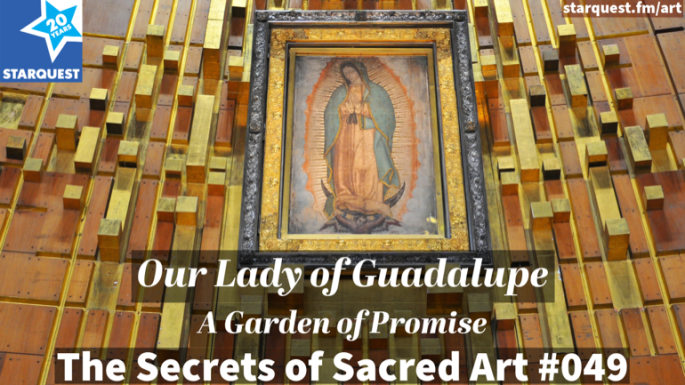
SSA049: The image on Juan Diego’s tilma has survived nearly 500 years — bombed, acid-spilled, and exposed to the elements for over a century — and scientists still cannot fully explain it. Kathryn Laffrey and Alix Murray take a close look at what makes the miraculous image of Our Lady of Guadalupe one of the most studied and mysterious sacred objects in history.
The conversation opens with the story of Juan Diego: his apparitions on Tepeyac Hill in December 1531, his humble efforts to convince Bishop Zumarraga, and the moment he opened his tilma before the bishop to reveal not just the roses — but the image itself. Mary deliberately chose both a European artistic idiom the bishop would recognize and Mesoamerican symbolism that spoke directly to the indigenous people. The bridge was intentional.
The physical properties of the tilma are remarkable. The cloth is woven from cactus fiber — material that should not survive more than a few decades — yet it endured 120 years of open-air exposure before any protection. Studies in 1979 revealed reflections in Our Lady’s eyes consistent with a three-dimensional living eye, with ophthalmologists identifying up to 12 human figures. A more recent discovery shows what appears to be an entire family — a kneeling man, a woman with children, and an older couple behind them — reflected in the opposite eye. The stars on the mantle, mapped to piano keys, play a song.
The deeper meaning of the image runs through the quadrufoil flower at the center of Our Lady’s gown. The book Guadalupe and the Flower World Prophecy by Joseph and Monique Gonzalez — which Kathryn credits for transforming her understanding — traces 3,000 years of Mesoamerican mythology through Olmec, Nahuatl, and other cultures. Their paradise, called Flower World, was accessed through a five-pointed axis mundi; the quadrufoil represented this axis and the longing for heaven. A poem within this tradition, written 3,000 years before Juan Diego, describes a man who hears birds singing on a sacred mountain, climbs toward the music, picks flowers, and brings them to the people. It maps almost exactly to the events of December 1531 — and the first translations of those poems into Spanish came 25 years after the apparition, making any claim of fabrication difficult to sustain.
Kathryn and Alix also walk through the early copies of the tilma, the 1921 bombing during the Cristeros War that left the image untouched, and the two basilicas at Tepeyac: the original 1709 structure and the sweeping 1979 circular basilica designed to receive the millions of pilgrims who come each year.
Get all new episodes automatically and for free:
Follow by Email | Watch this episode and subscribe on YouTube.
 Apple Podcasts
 Spotify
 YouTube
 Amazon Music
 TuneIn
 RSS
RSSHelp us continue to offer The Secrets of Sacred Art. Won’t you make a pledge at SQPN.com/give today?
Links for this episode:
- Nican Mopohua (Codex 1548) – Miracle Hunter
- Pope Leo XIV Celebrates Mass for Our Lady of Guadalupe | St. Peter’s Basilica | Dec 12, 2025
- The Musical Melody Hidden in the Tilma – EWTN CHPOP
- Our Lady of Guadalupe – Arcane Knowledge
- Guadalupe: The hidden message in her eyes
- New Research on Our Lady of Guadalupe: The Flower World Story
- Official Basilica of Our Lady of Guadalupe Website
- Our Lady of Guadalupe – EWTN
- Juan Bernardino – Wikipedia
- So Far, So Close: Guadalupe of Mexico in Spain – Museo del Prado
- Virgin of Guadalupe – Museo del Prado Collection
- The Immaculate Conception (1537) – Juan de Juanes
- Our Lady of Guadalupe Resources – Knights of Columbus
- Leave us a review on Apple Podcasts!
- Email us feedback or comments to [email protected]
Want to Sponsor A Show?
Support StarQuest’s mission to explore the intersection of faith and pop culture by becoming a named sponsor of the show of your choice on the StarQuest network. Click to get started or find out more.