Clothed in Glory: The Art and Theology of Priestly Vestments
Podcast: Download
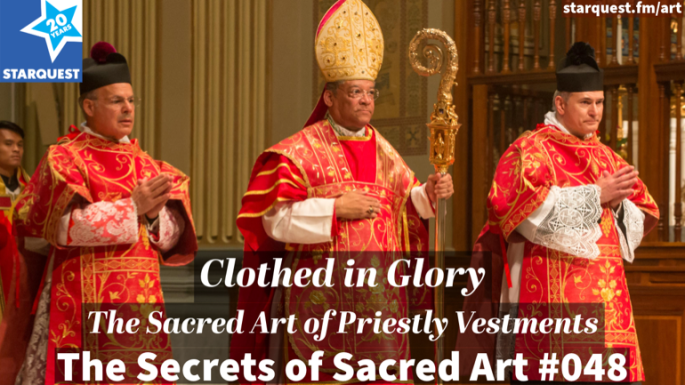
SSA048: Kathryn Laffrey and Alix Murray take a deep look at one of the most visually rich — and spiritually layered — elements of the Catholic liturgy: the vestments worn by priests, deacons, and bishops.
The conversation opens by challenging a common assumption: that Catholic priestly vestments draw from Old Testament tradition. They don’t. Through paintings of Aaron and early synagogue frescoes — including the stunning third-century Dura-Europos frescoes — Kathryn and Alix show how vestments evolved from Roman dress, with early Coptic Christian tunics serving as a key visual bridge.
From there, the episode works through each layer of the vestment sequence — amice, alb, cincture, maniple, stole, and chasuble — explaining the theological symbolism and vesting prayer accompanying each piece. The chasuble, which means “little house,” also carries the imagery of a shepherd’s working cloak: the priest robed as shepherd, the congregation as flock. Gothic and Roman (fiddle-back) chasuble styles are compared, and the divergent path of Eastern vestment evolution — bringing the front hem up rather than shortening the sides — adds a revealing comparative lens.
The case for natural fibers runs throughout: linen, silk, and wool not only breathe and wear better than synthetics, they survive. The evidence is extraordinary. The Syon Cope (c. 1300–1320) is a masterwork of Opus Anglicanum — English medieval embroidery in which every inch of fabric is covered in contour-following stitches that give the impression of infinite, God-like depth. Vestments from Shrewsbury Cathedral, including pieces attributed to A.W.N. Pugin, are showcased in rare close-up photographs. Albs made by St. Clare (13th century) and St. Bernadette round out the evidence for how long well-crafted vestments can endure.
Throughout, Kathryn and Alix read vestments in sacred art — works by Rubens, Juan de Juanes, and Valdés Leal — showing how vestment details encode meaning: the red chasuble on St. Ignatius of Loyola suggesting self-martyrdom; the deacon’s sleeves on St. Stephen marking readiness to serve. English alabaster reliefs of St. Thomas Becket offer a window into how vestments were depicted and understood in medieval England.
The episode ends with its theological center: as the priest is vested, the man decreases and Christ increases. The beauty of vestments is not for the priest — it is for God.
Get all new episodes automatically and for free:
Follow by Email | Watch this episode and subscribe on YouTube.
 Apple Podcasts
 Spotify
 YouTube
 Amazon Music
 TuneIn
 RSS
RSSHelp us continue to offer The Secrets of Sacred Art. Won’t you make a pledge at SQPN.com/give today?
Links for this episode:
- Why does POPE LEO have two little LAMBS? (YouTube)
- The History of Liturgical Vestments in the Catholic Church
- The Pontifical Mass of Cardinal Arinze at Corpus Christi (Photo Set)
- Treasure and Tradition: Guide to the Latin Mass
- The Development of the Shape of Eastern Vestments
- Leave us a review on Apple Podcasts!
- Email us feedback or comments to [email protected]
Want to Sponsor A Show?
Support StarQuest’s mission to explore the intersection of faith and pop culture by becoming a named sponsor of the show of your choice on the StarQuest network. Click to get started or find out more.