Music of the Legendarium
Podcast: Download
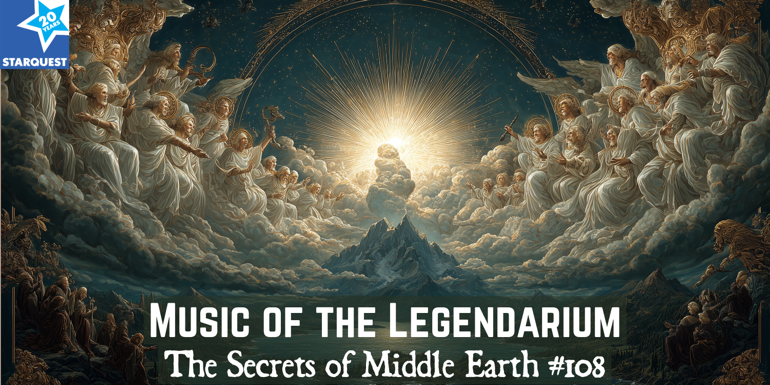
SME108: In the beginning, there was music — and from music, Arda itself was made. The Ainulindalë, Tolkien’s creation myth, places music not as decoration but as the mechanism of existence: Eru Ilúvatar’s great theme sung into being by the Valar, fractured by Melkor’s discord. Jeff Haecker, Alix Murray, and Patrick Mason follow that thread from the cosmological to the personal, tracing how music functions across the full span of the legendarium.
From Tulkas driving Melkor from the earth with a storm of laughter and loud song, to Lúthien’s spellsong lulling Morgoth to sleep in Angband — and her famous sorcery duel with Sauron over the walls of Tol-in-Gaurhoth — the panel shows how music functions as genuine power in Middle-earth, not merely a cultural flourish. Ulmo, lord of waters, reaches the inhabitants of Arda through sound itself, his servants wielding horns to move the sea.
The Hobbit brought Tolkien’s songs to wide readership first. The playful Chip the Glasses, the Goblin Town ditty, and the haunting Misty Mountains Cold — still the most frequently adapted Tolkien song — sit alongside The Road Goes Ever On, a walking song deceptively simple on the surface, carrying far more weight on a second reading. The Rings of Power’s Dwarven Stone Singers receive a brief nod as a cultural contrast: where Elves sing of history across ages, Dwarves sing to find more stone.
In The Lord of the Rings, songs accumulate purpose. Bilbo’s Song of Eärendil transmits ancient history in verse; the Riddle of Strider is equal parts defense of Aragorn and declaration of identity. Tom Bombadil speaks and sings almost interchangeably — his songs are literal weapons against Old Man Willow and the Barrow-wights. In Bree, the Hey Diddle Diddle echo in Frodo’s impromptu performance isn’t an intrusion; it’s a medieval original bleeding forward into a modern nursery rhyme.
The Rohirrim are defined by their music above all. Aragorn calls them generous in thought, wise but unlearned, riding no books but singing many songs — and the battle charge at Pelennor Fields bears it out. Théoden seizes the great horn, blows it until it bursts asunder, and the host sings as they slew. The panel connects every great horn blast throughout the novels — Helm Hammerhand’s, Boromir’s, the Grey Company’s — back to Oromë the Hunter, whose primordial horn echoes through the ages.
The episode closes with Return of the King’s quieter musical moments: Malbeth’s prophecy over the Paths of the Dead, the elegiac Song of the Mounds of Mundburg, and the Athelas verse in the Houses of Healing — where the power of the herb depends on whose hands hold it.
Get all new episodes automatically and for free:
 Apple Podcasts
 Spotify
 YouTube
 TuneIn
 RSS
RSSFollow by Email | Listen to this episode and subscribe on YouTube.
Help us continue to offer the Secrets of Middle Earth. Won’t you make a pledge at SQPN.com/give today?
Links for this episode:
- Leave us a review on Apple Podcasts or wherever you get your podcasts!
- You can watch The Rings of Power on Amazon Prime.
- Purchase J.R.R. Tolkien books and Blu-ray/DVDs at the Secrets of Middle Earth Store.
- Join the conversation at the SQPN Facebook page.
- Be part of the StarQuest Discord community at SQPN.com/discord
- Send your feedback or comments to [email protected]
Want to Sponsor A Show?
Support StarQuest’s mission to explore the intersection of faith and pop culture by becoming a named sponsor of the show of your choice on the StarQuest network. Click to get started or find out more.
Code: