Here There Be Dragons!
Podcast: Download
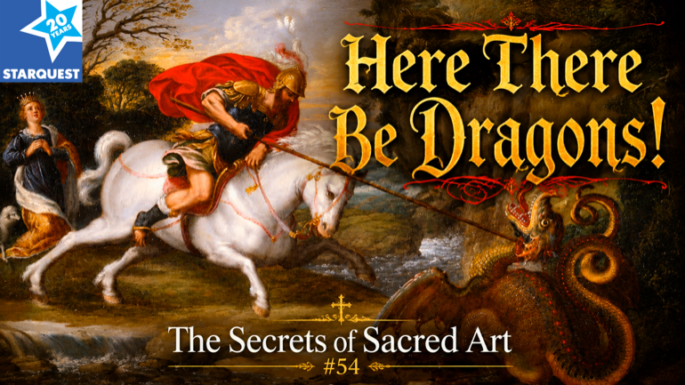
SSA054: Dragons haunt Christian sacred art for over a thousand years, and their meanings shift in almost every context. The Leviathan frolics in the sea in Psalm 104, at God’s command. The great beast that swallowed Jonah obeyed God’s will. The same creature that represents chaos and sin can, in the same tradition, represent creation’s obedience.
Kathryn Laffrey and Alix Murray trace dragon symbolism in medieval and sacred art across Episode 54 of Secrets of Sacred Art, moving from scripture through the Aberdeen Bestiary to contemporary icon painting.
They start with translation. The Hebrew word tannin can mean serpent, dragon, or jackal. The King James Bible gives Jeremiah 10:22 as “a den of dragons” where modern translations say “a lair of jackals.” The Greek monokeros (“one-horned”) moved through the Septuagint into Latin as unicornis, giving the Bible its famous unicorns. What looked fantastic was often something real, refracted through centuries of translation.
The Aberdeen Bestiary sets the visual grammar: the dragon is the largest of all creatures, drawn from caves into the open air, causing the air to become turbulent. From there the episode moves through the most important pieces of Christian dragon art: the human-faced serpent coiled around the tree in Eden (Notre Dame, 12th-13th century), the Brazen Serpent of Moses now in Sant’Ambrogio Basilica in Milan, the Laocoön group excavated in Rome in 1506 and its influence on Renaissance depictions of serpentine suffering.
Saints with dragons get their own section. St. Martha tames the Tarasque, a creature half beast and half fish, greater than an ox and longer than a horse, leading it on a leash through Provence. St. Margaret of Antioch bursts from the dragon’s side, clean, with her cross. St. Michael the Archangel transfixes the devil, which shifts from monstrous to almost human as the spear goes in.
The episode closes with Our Lady and the serpent: the proto-evangelium in Genesis, Caravaggio’s Madonna and Child with St. Anne, Tiepolo’s Immaculate Conception, and a stained glass window from Oxfordshire where the dragon’s tail literally sweeps the stars from the sky.
Also covered: Daniel Mitsui’s contemporary dragon art, the surprising Weimar Altarpiece by Lucas Cranach the Younger (which includes Martin Luther in a thoroughly Catholic composition), and the chalice of St. John the Evangelist with its poison-signifying snakes.
Get all new episodes automatically and for free:
Follow by Email | Watch this episode and subscribe on YouTube.
 Apple Podcasts
 Spotify
 YouTube
 Amazon Music
 TuneIn
 RSS
RSSHelp us continue to offer The Secrets of Sacred Art. Won’t you make a pledge at SQPN.com/give today?
Links for this episode:
- Aberdeen Bestiary, Folio 66r
- St. Michael the Archangel — Kathryn Laffrey
- Grandes Heures d’Anne de Bretagne — Gallica
- Does the Bible Teach That Unicorns and Dragons Exist?
- A Brief Catholic Guide to Dragons, from Eden to Today
- The Bronze Snake of Moses in a Basilica
- The Brazen Serpent — Imagine Dei
- St. Veranus of Cavaillon — Catholic Online
- Liphardus — Wikipedia
- Cathédrale Notre-Dame-et-Saint-Véran de Cavaillon — Wikipédia
- Notre-Dame and Saint-Véran Cathedral in Cavaillon — Luberon Heritage
- Laocoön and His Sons — Wikipedia
- Daniel Mitsui

- Leave us a review on Apple Podcasts!
- Email us feedback or comments to [email protected]
Want to Sponsor A Show?
Support StarQuest’s mission to explore the intersection of faith and pop culture by becoming a named sponsor of the show of your choice on the StarQuest network. Click to get started or find out more.