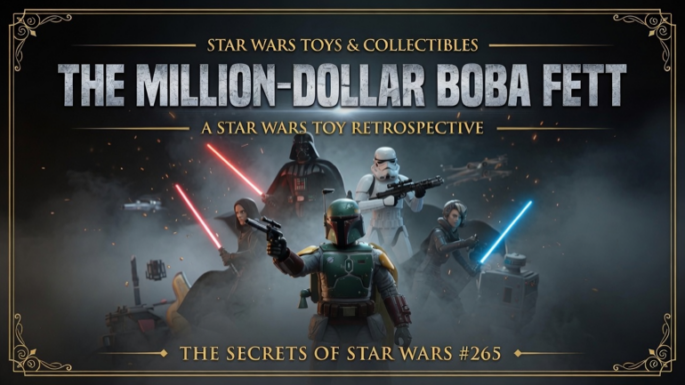
The Million-Dollar Boba Fett: A Star Wars Toy Retrospective
Podcast: Download
SSW265: A rocket-firing Boba Fett prototype that was never supposed to exist is now the most expensive toy ever sold at auction: $1.34 million. That’s the anchor for a nostalgia-heavy tour through five decades of Star Wars merchandise, from a manufacturer nobody else wanted the job to a shelf of Black Series figures nobody can afford to finish collecting.
Jeff Haecker, Jon Koral, Kathryn Laffrey, and Thomas Salerno open with the origin story: George Lucas kept the merchandising rights when 20th Century Fox didn’t want them, and when Star Wars exploded in popularity in 1977, there were no toys on shelves to meet the demand. Kenner, a small toy company that took a job bigger manufacturers passed on, patched the gap with the infamous Early Bird Certificate Package — a mail-in voucher for four figures that didn’t actually ship until 1978. The panel also traces the era’s real toy competition: G.I. Joe and Barbie, plus the Battlestar Galactica toy line that landed in a lawsuit over knocking off Star Wars.
From there it’s personal. Jon Koral got hooked after seeing The Empire Strikes Back as a kid and remembers hunting down the elusive Boushh figure. Kathryn Laffrey never had many Star Wars toys of her own — she points to the competing toy landscape of 1977-78 and a wave of anti-Star Wars sentiment in some Christian circles at the time — but remembers the Sears catalog and a friend’s Darth Vader carrying case vividly. Thomas Salerno and his brother collected prequel-era figures and playsets, inherited a six-foot cardboard Darth Vader store standee from a Blockbuster-employee aunt, and built custom LEGO starships out of mismatched sets. Jeff Haecker bought his first figures at a collector show in the mid-90s and kept them mint in the package, display-only, never opened.
The conversation moves through Expanded Universe/Legends-era collecting (Thrawn Trilogy tie-in figures, the Essential Guide reference books, Marvel’s early comics run and Dark Horse’s later expansion), a side note on why Phantom Menace-era Jedi Council figures shipped with lightsaber colors that don’t match the films (the figures were made before those details were locked in), and Mace Windu’s now-famous purple lightsaber, which Samuel L. Jackson requested so he could find himself onscreen during the Geonosis arena battle.
Modern collecting gets its due too: LEGO Star Wars kitbashing, Funko Pop subscription boxes, Hasbro’s Black Series line, and Disney park experiences — droid-building, lightsaber customization, and the now-closed Galactic Starcruiser — that brought childhood imagination full circle. Kathryn Laffrey closes with an observation that echoes throughout the episode: a kid’s collection often just mirrors what their parents collected.
Get all new episodes automatically and for free:
 Apple Podcasts
 YouTube
 Spotify
 Amazon Music
 TuneIn
 RSS
RSSFollow by Email | Listen to this episode and subscribe on YouTube.
Help us continue to offer the Secrets of Star Wars. Won’t you make a pledge at SQPN.com/give today?
Links for this episode:
- Leave us a review on Apple Podcasts or wherever you get your podcasts!
- You can watch most Star Wars on Disney+.
- Get the official Secrets of Star Wars t-shirt at sqpn.com/merch.
- Purchase Star Wars books and Blu-ray/DVDs at the Secrets of Star Wars Store.
- Join the conversation at the SQPN Facebook page and the Secrets of Star Wars discussion group.
- Be part of the StarQuest Discord community at SQPN.com/discord
- Send your feedback or comments to [email protected]
Want to Sponsor A Show?
Support StarQuest’s mission to explore the intersection of faith and pop culture by becoming a named sponsor of the show of your choice on the StarQuest network. Click to get started or find out more.