Nine Hundred Years in an Empty Field
Podcast: Download
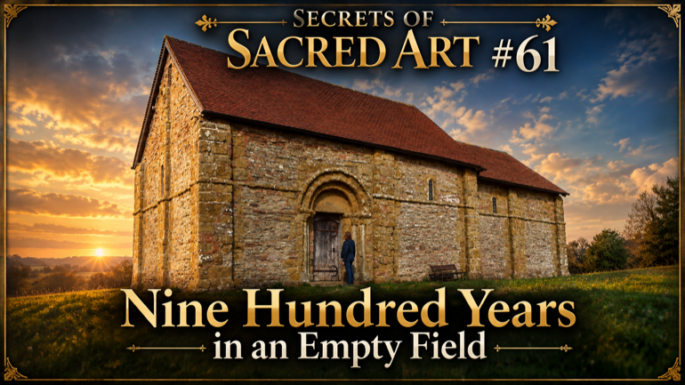
SSA061: There is a field in south Shropshire with a chapel standing in the middle of it, and the key to the front door hangs on the signpost at the bottom of the hill. No car park, no attendant. You fetch the key and let yourself in.
Alix Murray lives near Heath Chapel and went out there with her daughter, a friend and the dogs. What she brings back to Kathryn Laffrey in this Rabbit Hole conversation is not really a tour. It is a demonstration of what a stocked visual memory does to a building.
Alix starts with a test. She puts the carved doorway on screen and asks Kathryn to say, from the arch alone, who stood behind the chapel nine centuries ago. Kathryn reads the chevrons — the deep zigzag mouldings cut into the arch orders — connects them to what she has seen at Lindisfarne and Durham, and names a monastic order. That exchange is the point of the episode. Not the answer, but the fact that a building can be interrogated at all by someone who has looked at enough of them.
Heath Chapel rewards the looking. It went up in the middle of the twelfth century and it is Grade I listed, described by Historic England as “nationally very remarkable as it has remained substantially unaltered in use, status, size and style.” Two cells, nave and chancel. No tower, no aisles, small round-headed windows with deep internal splays, and a cylindrical Norman tub font that has not moved. Most English parish churches were enlarged, re-windowed and Victorianised. Heath was not, because the settlement that would have paid for it dwindled to almost nothing. The depopulation is why the architecture survives.
The nave wall is where the history gets loud. A medieval painted figure sits there, and beside it the ghost of the painted Scripture text that covered it at the Reformation, and over that, later, plain whitewash. Image, then word, then nothing: the English argument about sacred art, layered on one wall in the order it happened.
Alix worked the medieval figure out before she read the chapel’s pamphlet. A cross held at an angle, a dark arc across the front, a longer line hanging behind like a sword, and above it the suggestion of castellations. St George — and Historic England’s list entry says the same, recording a lion on the north wall besides.
Kathryn, who sees small timber churches all over Michigan, names what the stone is doing. Those wooden churches are lovely, she says, and they do not carry this. Alix’s phrase for it is quiet strength. The chapel was neglected, patched, restored and neglected again; the wall paintings were only uncovered during the 1911–12 repairs, with parts of the building close to collapse. It is still standing, and services are still said in it.
One question gets left hanging for listeners at the end. It is answered in the notes.
Get all new episodes automatically and for free:
Follow by Email | Watch this episode and subscribe on YouTube.
 Apple Podcasts
 Spotify
 YouTube
 Amazon Music
 TuneIn
 RSS
RSSHelp us continue to offer The Secrets of Sacred Art. Won’t you make a pledge at SQPN.com/give today?
Links for this episode:
- Leave us a review on Apple Podcasts!
- Email us feedback or comments to [email protected]
Want to Sponsor A Show?
Support StarQuest’s mission to explore the intersection of faith and pop culture by becoming a named sponsor of the show of your choice on the StarQuest network. Click to get started or find out more.