The Brutal Truth: Why Are Modern Catholic Churches So Ugly?
Podcast: Download
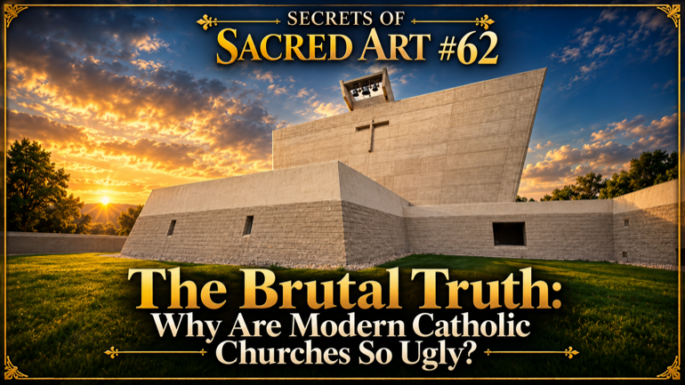
SSA062: Concrete that refuses to charm you. A facade that leans away when you look up at it, then leans the other way when you cross the aisle. A cathedral stairway with no railing, where five people fell in a single afternoon. Brutalist churches are the buildings Catholics complain about more than any others, and this week the complaint gets a hearing.
Kathryn Laffrey and Alix Murray take up the subject listeners kept asking for: where brutalist architecture came from, how Catholic parishes ended up with it, and whether a church can do its work while the building works against it.
The origin is not aesthetic. Brutalism grew out of postwar reconstruction — housing, hospitals and schools needed fast — but the ideas came with the material: a deliberate rejection of the past, buildings meant to embody a socialist utopia, and function over form so total that beauty itself reads as dishonest until the utopia arrives. You cannot reject the past, Alix argues, without rejecting the Church. Then she reads the adjectives used by critics who love it: disorienting, jarring, isolating, irrational.
The tour takes in Gottfried Böhm’s Mariendom at Neviges, Fritz Wotruba’s stacked concrete in Vienna, Le Corbusier at Ronchamp and La Tourette, and Sir Frederick Gibberd’s Metropolitan Cathedral of Christ the King in Liverpool — Mass, as Alix puts it, in a galaxy far, far away, and where she watched five people fall on the steps.
Then Kathryn’s own visit. St. Francis de Sales in Norton Shores, Michigan is Marcel Breuer’s, commissioned in 1961 and opened at Christmas 1966: a seventy-five-foot trapezoid “banner” for a facade, hyperbolic paraboloid side walls, 32,000 square feet for roughly a million dollars. She finds real Catholic bones in it — steps up to the sanctuary, a baldachin standing for the cloud of heaven, the font set in the narthex so you enter the church through baptism — and archived drawings better still, with an altar designed for Mass said either way.
She also finds the building fighting her. The front leans away from you from one end of the balcony and away again from the other; the parish secretary calls the effect dangerous, and visitors looking up have lost their balance and fallen. Pews came out to make room for wheelchairs. The tabernacle was moved off a narrow, railless stair. Kathryn could not find the red lamp — and, left alone in the nave, started to cry.
What the two of them are finally arguing about is not taste. Beauty is a transcendental, with clarity, integrity and proportion as its conditions, and a church is supposed to be a small taste of heaven. Abbot Suger said as much on the doors of Saint-Denis: the dull mind rises to truth through material things. Ten minutes from Norton Shores, a Polish parish simply does it.
Get all new episodes automatically and for free:
Follow by Email | Watch this episode and subscribe on YouTube.
 Apple Podcasts
 Spotify
 YouTube
 Amazon Music
 TuneIn
 RSS
Help us continue to offer The Secrets of Sacred Art. Won’t you make a pledge at SQPN.com/give today?
Links for this episode:
- The Heavy Hand of God: Europe’s Brutalist Churches – in Pictures
- Saint Francis de Sales Church – Michigan Modern
- View All Objects – Marcel Breuer Digital Archive
- What Is the Anatomy of a Catholic Church: Nave, Altar, and More?
- Leave us a review on Apple Podcasts!
- Email us feedback or comments to [email protected]
Want to Sponsor A Show?
Support StarQuest’s mission to explore the intersection of faith and pop culture by becoming a named sponsor of the show of your choice on the StarQuest network. Click to get started or find out more.