Beware: The Drop Croc!
Podcast: Download
SCI096: Fifty-five million years ago, Australia’s forests were full of crocodiles — not just at the water’s edge, but possibly in the trees. Caroline Knight and Lindsay Sant look at groundbreaking research published in the Journal of Vertebrate Paleontology in November 2025, describing the oldest crocodilian eggshell ever found in Australia.
The eggshells were discovered at Mergon in southeastern Queensland, within the Tingamara local fauna site — a paleontological time capsule from the early Eocene. This was a period when Australia was still drifting away from Antarctica, the climate was warm and humid, and the landscape was dominated by lakes and swamps. Alongside early marsupials, songbirds, turtles, and snakes, the dominant predators were the mycosuchine crocodilians — a family of extinct reptiles quite unlike anything alive today.
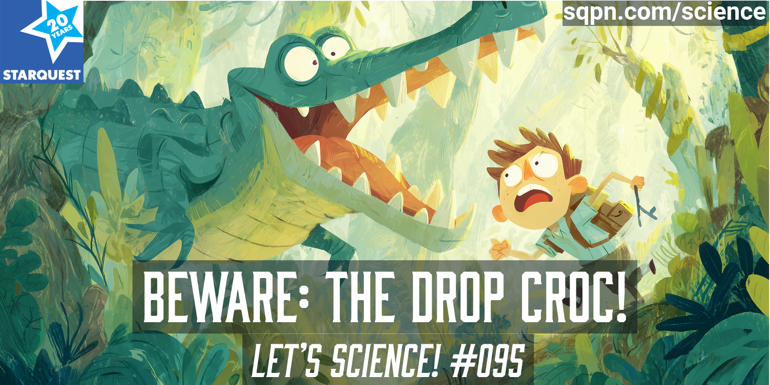
Unlike modern crocodiles, which are largely aquatic, the mycosuchines occupied a range of ecological niches. Some were small and highly terrestrial; others may have been semi-arboreal — capable of climbing trees. Scientists have proposed the nickname “drop crocs” for these extinct reptiles, suggesting they may have ambushed prey from the forest canopy, much like leopards do today. Before the arrival of modern saltwater and freshwater crocodiles, the mycosuchines had no competition and were free to evolve into every shape and size: blade-toothed land hunters like Quinkana, short-faced dwarfs, and semi-aquatic forms like Baru.
The research team examined 12 fossil eggshell fragments using petrographic thin sections (just 30 micrometers thick — thinner than a human hair) and scanning electron microscopy to analyze the shells’ internal crystal structure. The analysis confirmed these fragments match no known crocodilian eggshell type, making them a brand-new scientific classification formally named Wakaoolithus godelpi, honoring the Waka First Nations people of the region and researcher Henk Godelp.
The conversation also turns to modern crocodiles: a firsthand account of Australia Zoo’s dramatic demonstration of a croc’s burst-energy hunting behavior, the massive specimens on display at Ballarat Wildlife Park and the Melbourne Aquarium, and even a giant Australian croc spotted at the Dubai Aquarium. The hosts also consider what the tree crocs must have looked like physically — lighter, clawed, built for the canopy — and speculate about whether other prehistoric predators occupied similar niches.
Get all new episodes automatically and for free:
 Apple Podcasts
 YouTube
 Spotify
 Amazon Music
 TuneIn
 RSS
RSSFollow by Email | Listen and subscribe on YouTube.
Help us continue to offer Let’s Science. Won’t you make a pledge at SQPN.com/give today?
Links for this episode:
- 55-million-year-old fossils reveal bizarre crocs that dropped from trees | ScienceDaily
- Australia’s oldest crocodylian eggshell: insights into the reproductive paleoecology of mekosuchines
- If you enjoy Let’s Science, check out Caroline and Lindsay and Lino’s other show, Catholics of Oz.
- Leave us a review on Apple Podcasts!
- Email us feedback or comments to [email protected]
- Be part of the StarQuest Discord community at SQPN.com/discord
Want to Sponsor A Show?
Support StarQuest’s mission to explore the intersection of faith and pop culture by becoming a named sponsor of the show of your choice on the StarQuest network. Click to get started or find out more.