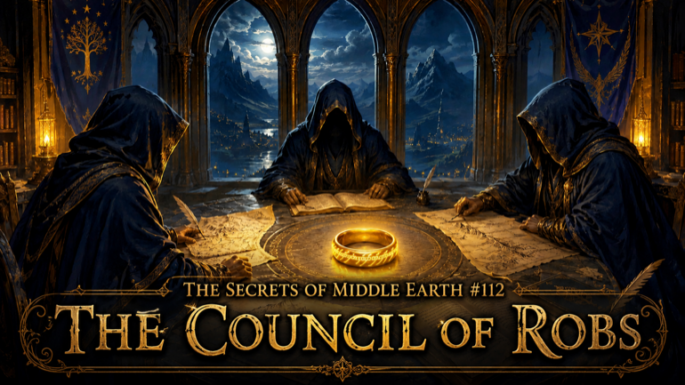
The Council of Robs
Podcast: Download
SME112: Is Rings of Power worth watching for Tolkien fans? Three new voices on Secrets of Middle-Earth tackle that question head-on. Rob Leonardi, Robert Story, and Fr. Bryan Shackett — none of whom participated in the original coverage of Seasons 1 and 2 — bring fresh eyes to the Amazon Prime series alongside host Patrick Mason, and their conclusions are specific, argued, and occasionally heated.
The panel’s consensus high points track what listeners have heard before: the Elrond and Durin friendship remains the best-written and best-acted arc in the series — a story that captures something true about the way different kinds of beings experience time, loyalty, and loss. Disa is praised as one of the most believable characters across both seasons. The Numenor arc delivers the political intrigue and encroaching dread that makes the Second Age worth dramatizing at all.
The best material in either season belongs to the Celebrimbor and Annatar arc in Season 2. The deception of Celebrimbor by a disguised Sauron, the scene in which Celebrimbor realizes he has been working in a loop, and his death scene calling Annatar the Lord of the Ring are singled out as the strongest moments in the series’ run. Charlie Vickers’ transformation through makeup into Annatar — distinctive enough that one panelist initially assumed the role had been recast — is called a production standout.
The criticisms are equally concrete. Galadriel in Season 1 is written as a generic fantasy protagonist who, the panel argues, causes more chaos than Sauron himself — not a mischaracterization so much as an entirely different character wearing her name. The Harfoot/Hobbit subplot receives near-universal criticism: the hobbits’ deliberate absence from the great events of the Second Age is precisely what makes them invisible to Sauron in The Lord of the Rings, and multiple seasons of proto-hobbit wandering undercuts that. The show is also taken to task for operating as Peter Jackson fanfiction rather than establishing its own identity — Eagles that don’t speak, narrative callbacks to the Jackson films, a visual language that tracks the cinematic universe rather than Tolkien’s descriptions.
The theological thread runs through the episode as well. Was Adar — the corrupted elf briefly restored by a ring — ultimately saved? Fr. Shackett makes the case that Adar’s arc maps the visible battle between fallen and created natures, and that the ring’s momentary restoration functions as something like a grace.
The episode opens with a round of Tolkien news: an unearthed 1966 letter confirms the walking elms in The Fellowship of the Ring were Ents dispatched by Gandalf to watch the Shire; a new illustrated Hobbit with Tove Jansson’s 1960 artwork is due out later this year; and Peter Jackson has announced he is working with the Tolkien Estate on possible Silmarillion adaptations. A full discussion of Pope Leo’s Gandalf encyclical quote is promised for a future episode.
Get all new episodes automatically and for free:
 Apple Podcasts
 Spotify
 YouTube
 TuneIn
 RSS
RSSFollow by Email | Listen to this episode and subscribe on YouTube.
Help us continue to offer the Secrets of Middle Earth. Won’t you make a pledge at SQPN.com/give today?
Links for this episode:
- Leave us a review on Apple Podcasts or wherever you get your podcasts!
- You can watch The Rings of Power on Amazon Prime.
- Purchase J.R.R. Tolkien books and Blu-ray/DVDs at the Secrets of Middle Earth Store.
- Join the conversation at the SQPN Facebook page.
- Be part of the StarQuest Discord community at SQPN.com/discord
- Send your feedback or comments to [email protected]
Want to Sponsor A Show?
Support StarQuest’s mission to explore the intersection of faith and pop culture by becoming a named sponsor of the show of your choice on the StarQuest network. Click to get started or find out more.
Code: