Roverandom
Podcast: Download
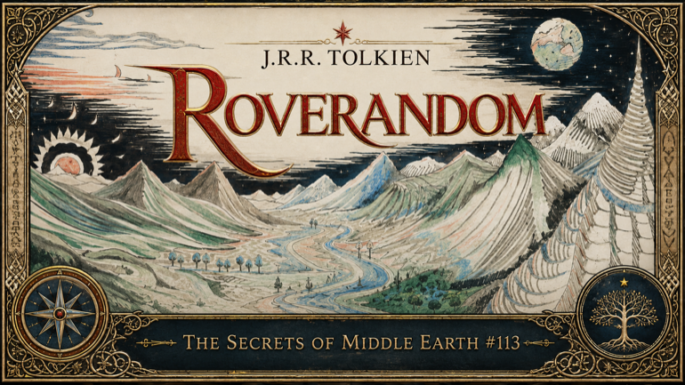
SME113: A dog bites a wizard’s trousers, gets turned into a toy for his trouble, and spends the rest of the story trying to get his size — and his name — back. That’s the premise of J.R.R. Tolkien’s Roverandom, and on this episode Thomas Salerno is joined by Rob Leonardi, Rob Story, Fr. Bryan Shackett, and Patrick Mason for a full Roverandom summary and analysis — plus the story behind the story.
Tolkien invented Roverandom on the spot to console his son Michael after the family lost his toy dog on the beach at Filey, Yorkshire in September 1925. He wrote the tale down two years later, and what began as a bedtime story to soothe a heartbroken child grew into a surprisingly long, five-chapter odyssey that carries its toy-dog hero from a toyshop to the moon to the bottom of the sea — and, as more than one panelist notes on this episode, runs a lot longer than anyone expects going in.
The panel traces Roverandom’s stealth connections to Tolkien’s wider legendarium: the whale Uin, borrowed straight out of the Book of Lost Tales; a glimpse of Valinor and Elvenhome from the deck of a sea-dog’s adventure; an unnamed necromancer who hadn’t yet become Sauron. They also read the story alongside Tolkien’s essay “On Fairy-Stories” — Roverandom’s biting toy-dog, sand-sorcerer, and moon spiders check off nearly every box in Tolkien’s own theory of what makes a proper fairy tale.
There’s also the publishing history: submitted to George Allen & Unwin in 1936, praised by editor Rayner Unwin as “well written and amusing,” and then shelved for seventy years in favor of a straight sequel to The Hobbit — Roverandom didn’t see print until 1998, courtesy of HarperCollins.
Beyond the Tolkien Roverandom trivia, the panel digs into what the story is actually about: a proud, impatient dog who never thinks to say “please,” and who has to learn humility, patience, and gratitude before he’s allowed to go home. They also talk about why Tolkien, only a few years removed from the trench warfare of World War I, was still able to write something this purely whimsical — and why that whimsy might be the point.
Expect tangents on flat-earth cosmology, Ralph Bakshi rotoscoping, Guillermo del Toro’s Pinocchio, and exactly how many pages Tolkien can spend on a single mermaid joke.
Get all new episodes automatically and for free:
 Apple Podcasts
 Spotify
 YouTube
 TuneIn
 RSS
RSSFollow by Email | Listen to this episode and subscribe on YouTube.
Help us continue to offer the Secrets of Middle Earth. Won’t you make a pledge at SQPN.com/give today?
Links for this episode:
- Leave us a review on Apple Podcasts or wherever you get your podcasts!
- You can watch The Rings of Power on Amazon Prime.
- Purchase J.R.R. Tolkien books and Blu-ray/DVDs at the Secrets of Middle Earth Store.
- Join the conversation at the SQPN Facebook page.
- Be part of the StarQuest Discord community at SQPN.com/discord
- Send your feedback or comments to [email protected]
Want to Sponsor A Show?
Support StarQuest’s mission to explore the intersection of faith and pop culture by becoming a named sponsor of the show of your choice on the StarQuest network. Click to get started or find out more.
Code: