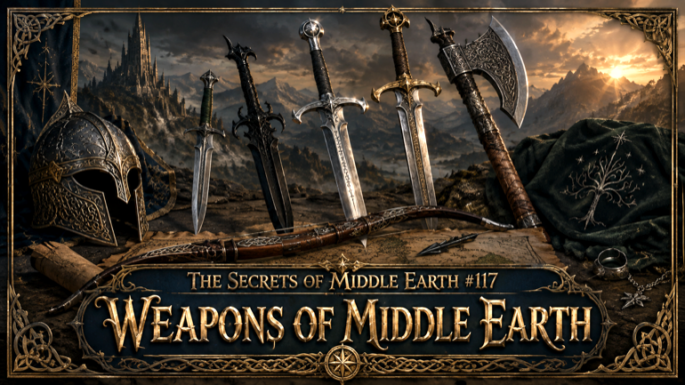
Weapons of Middle-Earth
Podcast: Download
SME117: “I do not love the bright sword for its sharpness, nor the arrow for its swiftness, nor the warrior for his glory. I love only that which they defend.” Faramir says it in The Two Towers, and since Tolkien named him the character closest to himself, it reads as his own position — and it rules out the obvious answer before the conversation starts.
Thomas Salerno, Jeff Haecker, and Fr. Bryan Shackett bar Andúril from the running — Middle-earth’s Excalibur, and everyone’s pick — and the episode is better for it.
Fr. Bryan takes the unnamed Barrow-blade Merry carries, the one that strikes behind the knee and breaks the spell knitting the Witch-king’s unseen sinews to his will. What he loves is Tolkien’s aside about the smith who forged it in a war Arnor lost, never knowing what his blade would undo. Jeff takes Anglachel, later Gurthang — Eöl’s meteoric black sword, carrying its maker’s malice, nearer the One Ring than any hero’s weapon. Thomas takes Sting, because the naming is the point: Bilbo kills the spider alone in Mirkwood, names the blade for it, and walks out of that scene a different hobbit — a name that turns prophetic when Sam carries it to Shelob.
From there it runs deep into the legendarium: Narsil, forged by the dwarf-smith Telchar and broken beneath Elendilbefore it was rechristened Flame of the West; Aranrúth, Thingol’s sword, carried through Elwing to Elros and lost in the Downfall of Númenor; Ringil at the gates of Angband, where Fingolfin wounds Morgoth seven times and leaves him limping forever after. That depth is why Middle-earth feels solid to readers who never opened The Silmarillion.
The best stretch is Húrin’s axe at the Battle of Unnumbered Tears and the cry Aurë entuluva — “Day shall come again.” That, the panel argues, is Tolkien’s answer to the Norse sagas he loved: the doomed last stand is northern courage with no hope in it. Ragnarök rebuilds the world without anyone who lived in it, and the Æsir are mortal and afraid of dying. Morgoth can be beaten.
Anglachel opens the real subject: subcreation. What a maker puts into a thing stays in it — Melian warns that the smith’s dark heart dwells in the sword; Sauron pours himself into the Ring. Eru’s answer to Morgoth in the Ainulindalë, that whoever attempts evil “shall prove but mine instrument in the devising of things more wonderful,” gets read alongside the Crucifixion.
It ends with small things. The Black Arrow that kills Smaug is an ordinary heirloom in the book, not the films’ ballista bolt, and it lands only because Bilbo noticed a bare patch and a thrush carried word to Bard. The greatest good comes through the simplest instrument.
Get all new episodes automatically and for free:
 Apple Podcasts
 Spotify
 YouTube
 TuneIn
 RSS
RSSFollow by Email | Listen to this episode and subscribe on YouTube.
Help us continue to offer the Secrets of Middle Earth. Won’t you make a pledge at SQPN.com/give today?
Links for this episode:
- Leave us a review on Apple Podcasts or wherever you get your podcasts!
- You can watch The Rings of Power on Amazon Prime.
- Purchase J.R.R. Tolkien books and Blu-ray/DVDs at the Secrets of Middle Earth Store.
- Join the conversation at the SQPN Facebook page.
- Be part of the StarQuest Discord community at SQPN.com/discord
- Send your feedback or comments to [email protected]
Want to Sponsor A Show?
Support StarQuest’s mission to explore the intersection of faith and pop culture by becoming a named sponsor of the show of your choice on the StarQuest network. Click to get started or find out more.
Code: