Your Lawn Just Went High-Tech
Podcast: Download
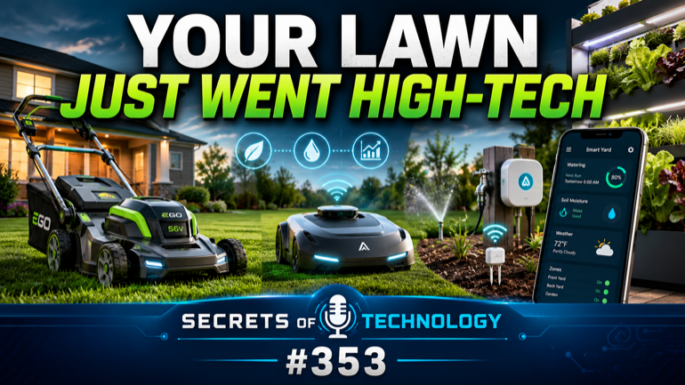
TEC353: The lawn is one of the last analog corners of the American home — and it’s quietly going high-tech.
Dom Bettinelli and Thomas Sanjurjo, two self-described suburban dads, walk through the gear reshaping how we mow, water, and grow. The conversation starts where most homeowners do: the mower. Electric and battery-powered mowershave closed the gap on gas, and Thomas makes the case that a mid-to-high-end battery mower can power through thick Bermuda grass on a single charge — no oil changes, no air filters, no gummed-up carburetor. The trade-offs are real, too: a higher upfront price and the battery-ecosystem lock-in that comes with every cordless tool.
From there they get into the smarter machines. Smart load-sensing mowers monitor the motor in real time and ramp power up only when the grass gets thick, stretching battery life. Zero-turn mowers add digital controls, and today’s decks mulch and bag far better than the rake-and-dump models of years past. Then there’s the future everyone’s watching: the robot lawn mower. Dom and Thomas compare boundary-wire models to GPS and dead-reckoning navigation, weigh whether a robot mower without a boundary wire is ready for a typical yard, and explain why the spinning blade means these trailed robot vacuums by about a decade on safety.
The back half turns to water and soil. A good smart irrigation system — weather-aware watering, soil-moisture sensors, zoned leak detection — may be the single best value in yard tech right now, ahead of a robot mower. They cover drip irrigation, wireless soil sensors from Moen and Netro, DIY builds on Raspberry Pi and Arduino, and the vertical planters and hydroponic system that have actually dented Thomas’s grocery bill. Modern plant identification apps — plus general AI tools and dedicated apps like Gardroid and Seed to Spoon — now diagnose sick plants and time your planting to your growing zone.
Underneath the gadgets is a quieter theme: technology that frees up time and helps a family be more responsible with water, chemicals, and the small patch of ground they tend. For the picks, Thomas recommends PulsePoint, the free app that alerts CPR-trained bystanders and maps nearby AEDs, and Dom shares MacWhisper, the Mac transcription app now running NVIDIA’s blazing-fast Parakeet model.
 Apple Podcasts
 YouTube
 Spotify
 Amazon Music
 TuneIn
 RSS
RSSGet all new episodes automatically and for free:
Follow by Email | Listen to this episode and subscribe on YouTube.
Help us continue to offer Secrets of Technology. Won’t you make a pledge at SQPN.com/give today?
Links for this episode:
- Ryobi
- Milwaukee Tool
- Husqvarna (robot mowers)
- Segway Navimow (robot mowers)
- Greenworks
- Moen Smart Wireless Soil Sensor
- Netro Whisperer Smart Plant Sensor
- Raspberry Pi
- Arduino
- Home Assistant
- ChatGPT
- Claude
- AeroGarden
- Gardroid (vegetable garden app)
- From Seed to Spoon
- Apple Home / HomeKit
- Google Home
- Matter (smart home standard)
- EGO 800 Series Select Cut with Touch Drive 21-in Self Propelled Battery Walk Mower
- Toro Recycler 22-in Gas Self-propelled lawn mower
- Leave us a review on Apple Podcasts!
- Join the conversation at the StarQuest Facebook page.
- Be part of the StarQuest Discord community at SQPN.com/discord
- Email us feedback or comments to [email protected]
Picks of the Week:
- Thomas: PulsePoint (AED / CPR responder app)
- Dom: MacWhisper
Want to Sponsor A Show?
Support StarQuest’s mission to explore the intersection of faith and pop culture by becoming a named sponsor of the show of your choice on the StarQuest network. Click to get started or find out more.
Disclaimer: Hosts, panelists, and guests may have a financial interest in the companies discussed through investments or other means. Their opinions and recommendations are not affected and do not present a conflict of interest. We offer this statement in the interest of full disclosure.