Babel or the City of God
Podcast: Download
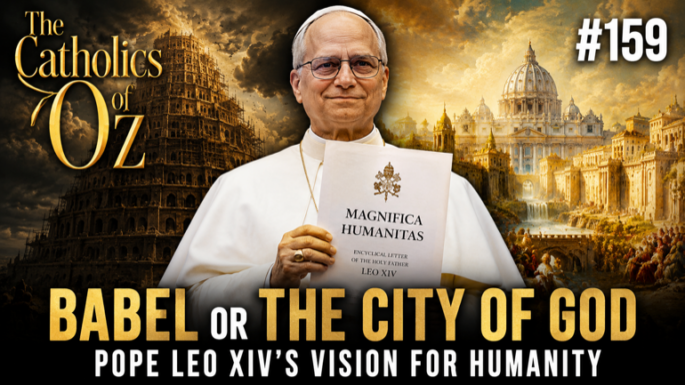
COZ159: Pope Leo XIV opens his first encyclical with a choice rather than a warning: “Humanity, created by God in all its grandeur, is today facing a pivotal choice: either to construct a new Tower of Babel or to build the city in which God and humanity dwell together.” Everything in Magnifica Humanitas follows from that sentence, and this is the first of three episodes working through it.
Lindsay Sant, Caroline Knight, and Lino Saubolle stay inside the introduction this week — there is already too much in it to rush. Leo picks up the thread from Leo XIII, whose 1891 Rerum Novarum read the “new things” of the Industrial Revolution through Catholic social teaching, and asks what the new things of our own moment are: digitization, artificial intelligence, robotics. His verdict on technology is not the expected one — it is “a profoundly human reality linked to the autonomy and freedom of man,” part of our history from the beginning rather than an enemy of it.
What has changed is who holds the power. In the past, Leo writes, it was largely the state that guided innovation; today the main drivers are private, often transnational parties with resources that surpass many governments. Caroline names the domestic version: software she used to buy once and own for life now rents to her by the month, and those companies answer to no vote she can cast.
Leo then hands over two pictures instead of a policy. Babel is a single language, a single technology, a single direction, raised without reference to God — and it ends in dispersion, not unity. Nehemiah, rebuilding the walls of Jerusalem, prays first, examines the ruins in silence, assigns each family a section, and answers the opposition. The city comes back “not through the initiative of one man, but through the shared responsibility of all.”
Lindsay puts a live example on the table: the manosphere as a working Tower of Babel — platforms selling dominance as manhood, monetized through courses, with followers who swarm anyone who asks a question. Caroline’s answer runs one sentence. The best influencer for a man to follow is Jesus Christ.
Leo closes the introduction with four asks: a firm relationship with God first; human limits accepted rather than treated as errors to be corrected; shared responsibility taken with courage; and an evangelical language that sheds light instead of humiliating people.
In the science segment, Caroline reports the first sugar ever found in interstellar space. Erythrulose — the four-carbon sugar also found in raspberries — turned up in the molecular cloud G+0.693−0.027 near the galactic centre, some 26,000 light-years away, confirmed by twelve matching spectral lines from radio telescopes in Spain. It proved at least eight times more abundant than the simpler three-carbon sugars, which weren’t detected at all.
Get all new episodes automatically and for free:
 Apple Podcasts
 YouTube
 Spotify
 Amazon Music
 TuneIn
 RSS
RSSFollow by Email | Listen to this episode and subscribe on YouTube.
Help us continue to offer Catholics of Oz. Won’t you make a pledge at SQPN.com/give today?
Links for this episode:
- Encyclical Letter of His Holiness Leo XIV Magnifica Humanitas (15 May 2026)
- Signs of sugar detected near centre of the Milky Way
- Detection of a four-carbon sugar in interstellar space | Nature Astronomy
- Leave us a review on Apple Podcasts!
- Email us feedback or comments to [email protected]
- Also check out our other podcast Let’s Science!
Want to Sponsor A Show?
Support StarQuest’s mission to explore the intersection of faith and pop culture by becoming a named sponsor of the show of your choice on the StarQuest network. Click to get started or find out more.
Thank you to Moon Shadow Studios
This episode of The Catholics of Oz was edited by Patrick McCaffrey of Moon Shadow Studios. To have your own audio professionally edited by Moon Shadow Studios visit them at their web site MoonShadowStudios.biz.