Sugar Between the Stars
Podcast: Download
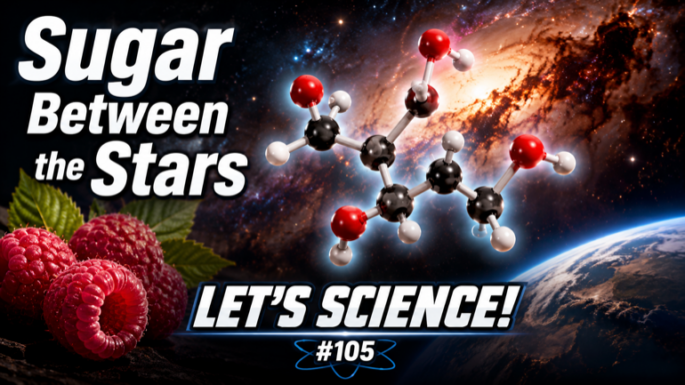
SCI105: Astronomers have found a real sugar molecule drifting free in interstellar space, 26,000 light years from Earth. On this planet the same sugar turns up in raspberries.
Caroline Knight brings the story to Lindsay Sant and Lino Saubolle. The molecule is erythrulose, a four-carbon sugar, published in Nature Astronomy by an international team led from Spain’s Centro de Astrobiología. Sugar-like molecules had been spotted before, and complex sugars pulled out of meteorites and the Bennu samples. A true sugar floating free in the gas between stars is new.
The hunting ground was a giant molecular cloud with the deeply unmemorable name G+0.693-0.027, sitting near Sagittarius A*, our galaxy’s supermassive black hole. That address matters. Clouds like this one are dense enough to block the ultraviolet light pouring off nearby stars, and UV light rips complex molecules apart in a process called photodissociation. The dust works like sunblock. Inside the shielded core, atoms settle onto icy dust grains and build structures that would be destroyed out in the open.
Then shockwaves tear through the cloud, warm the ice, and blast the finished molecules off the grains into the surrounding gas. That step is what makes them findable. A free-floating molecule rotates, and quantum mechanics restricts it to specific rates, so it emits radio waves at frequencies as distinctive as a barcode. Using the 40-meter Yebes telescope and the 30-meter IRAM telescope, both in Spain, the team matched 12 sets of spectral lines and confirmed erythrulose was sitting there.
The abundance is the part that rearranged the textbook. Astrochemists had assumed molecules in space build up one carbon at a time, like stacking Lego. Under that model, small three-carbon sugars should be everywhere and four-carbon sugars should be scarce. The team found the reverse. Erythrulose came in at least 8 times more abundant than the three-carbon sugars, and the three-carbon sugars weren’t detected at all. The likely explanation is that two-carbon pieces, glycolaldehyde and ethylene glycol, snap together directly and skip the intermediate stage. Space runs a faster chemistry than anyone had modeled.
There’s an origin-of-life angle too. Based on how much erythrulose is in that one cloud, the researchers estimate 500,000 to 50 million tons could have rained onto the young Earth during the heavy bombardment, dissolving into the primitive oceans and rearranging into other sugars. Ready-made building blocks for the first metabolic and genetic chemistry, delivered from orbit.
Which raises Lindsay’s question: if the space sugar is the same one in raspberries, are raspberries somehow cosmic? Caroline’s answer involves several billion years of plants working the problem out on their own.
Get all new episodes automatically and for free:
 Apple Podcasts
 YouTube
 Spotify
 Amazon Music
 TuneIn
 RSS
RSSFollow by Email | Listen and subscribe on YouTube.
Help us continue to offer Let’s Science. Won’t you make a pledge at SQPN.com/give today?
Links for this episode:
- Signs of sugar detected near centre of the Milky Way
- Detection of a four-carbon sugar in interstellar space | Nature Astronomy
- If you enjoy Let’s Science, check out Caroline and Lindsay and Lino’s other show, Catholics of Oz.
- Leave us a review on Apple Podcasts!
- Email us feedback or comments to [email protected]
- Be part of the StarQuest Discord community at SQPN.com/discord
Want to Sponsor A Show?
Support StarQuest’s mission to explore the intersection of faith and pop culture by becoming a named sponsor of the show of your choice on the StarQuest network. Click to get started or find out more.