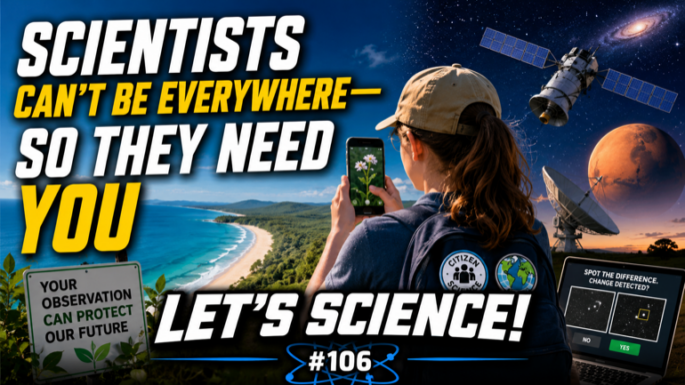
Scientists Can’t Be Everywhere — So They Need You
Podcast: Download
SCI106: Scientists can’t be everywhere. That’s not a complaint about funding — it’s a fact about a continent with more coastline than researchers, and it’s why a weed photographed by a stranger north of Brisbane in 2025 was eradicated by Biosecurity Queensland before it could take hold. The nearest known infestation was more than a thousand kilometres away.
Lindsay Sant and Lino Saubolle make the case that citizen science is the rare thing that is both genuinely useful and genuinely open — that you can contribute real data to real research today, from a phone, with no training and no degree.
The evidence comes first. The Atlas of Living Australia, the country’s largest open-source biodiversity data source, runs a Biosecurity Alerts Service with the Department of Agriculture, Fisheries and Forestry that pushes weekly notifications to biosecurity managers. Much of what feeds it comes from the public: the first Australian report of the invasive Asian shore crab in 2020, the first freshwater gold clam by an iNaturalist user in 2024. Climate History Australia took a different problem — millions of 19th-century weather observations that exist only on paper — and split scanned archive pages into chunks small enough to do at a kitchen table. More than 1,700 volunteers filled the gaps that now let us read Adelaide’s weather back to 1830 and Perth’s back to 1843. Kilonova Seekers hands you two images of the same patch of sky and asks you to play spot the difference; thousands of volunteers have produced more than 200 discoveries, one of them flagged as real three and a half hours after it appeared. Mozzie Monitors, out of the University of South Australia, has people setting low-tech traps at home and photographing what they catch — work that has turned up mosquito species not previously recorded in Australia.
Then the practical half: NASA citizen science projects you could start tonight. GLOBE Observer turns a smartphone into an instrument for clouds, land cover, mosquito habitat and tree height. Are We Alone in the Universe? asks you to learn the signatures of radio-frequency interference so real signals stand out — four minutes of training, and your classifications go on to train the AI doing the same job. Cloudspotting on Mars puts you in front of data from an orbiting Mars probe. Lindsay keeps returning to the line in NASA’s own requirements block: knowledge required, none.
There’s a family argument threaded through it, too: nearly all of this is something you can hand to a child, and Lindsay’s advice to anyone who wants their kids interested in science is to stop explaining it and let them do some.
The show closes where a Catholic science podcast should: science as a contribution to human knowledge, human dignity and human safety — and Pope Leo’s recent encyclical on reading science through the Gospel.
Get all new episodes automatically and for free:
 Apple Podcasts
 YouTube
 Spotify
 Amazon Music
 TuneIn
 RSS
RSSFollow by Email | Listen and subscribe on YouTube.
Help us continue to offer Let’s Science. Won’t you make a pledge at SQPN.com/give today?
Links for this episode:
- What we’ve learned from citizen science: 5 projects that made a difference (The Conversation)
- Atlas of Living Australia — Biosecurity Alerts Service
- iNaturalist Australia
- Climate History Australia
- Kilonova Seekers
- Mozzie Monitors — Australia
- WomSAT — Wombat Survey and Analysis Tool
- NASA Citizen Science — full project list
- GLOBE Observer
- Are we alone in the universe?
- Cloudspotting on Mars
- If you enjoy Let’s Science, check out Caroline and Lindsay and Lino’s other show, Catholics of Oz.
- Leave us a review on Apple Podcasts!
- Email us feedback or comments to [email protected]
- Be part of the StarQuest Discord community at SQPN.com/discord
Want to Sponsor A Show?
Support StarQuest’s mission to explore the intersection of faith and pop culture by becoming a named sponsor of the show of your choice on the StarQuest network. Click to get started or find out more.