St. Junípero Serra: Always Forward, Never Back
Podcast: Download
HTM007: He came ashore at Veracruz in 1749 to find horses waiting, arranged by the Spanish crown to carry the friars the 250 miles inland to Mexico City. He looked at them, said no thank you, and started walking. Somewhere on that road something bit his leg. The wound never fully closed again — not for one day of the thirty-five years he had left — and he turned down treatment for it, over and over, until it killed him.
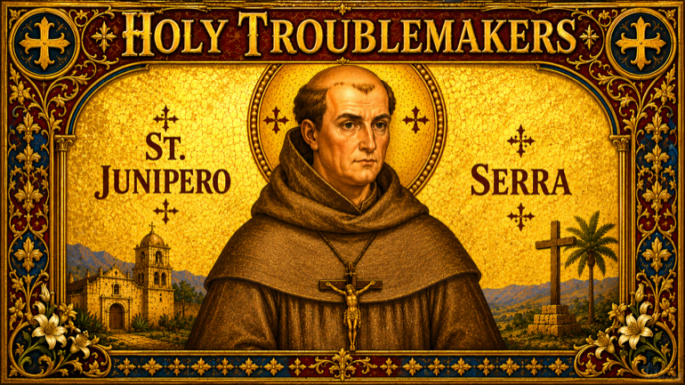
Dom Bettinelli tells the story of St. Junípero Serra without flinching in either direction, which is harder than it sounds. Most people arguing about whether Junípero Serra was good or bad have already decided which half of the record to keep.
The first half is a man in love. A brilliant sixteen-year-old from Petra, on Mallorca, receives the Franciscan habit and picks the name of Brother Juniper — St. Francis’s holy fool, the one who cut the foot off a live pig because a sick brother mentioned he’d like some pork. Then he inconveniently turns out to be brilliant at the other thing, takes a doctorate in theology and the chair of philosophy at Palma’s Lullian University, and at thirty-five walks away from all of it. The letter he writes home from the dock carries the sentence his whole life gets summarized by: siempre adelante, nunca atrás — always forward, never back. He never saw Mallorca or his parents again, and he knew it when he boarded.
The second half is why Junípero Serra is controversial. A mission was not a parish; it was a total institution. Baptized Native people lived there, worked there, and were not free to leave, and soldiers brought back the ones who ran. Serra approved of that, in his own handwriting, in 1775 and again in 1780. Behind those letters sits something larger and worse: roughly 300,000 Native people in California before 1769, down to around 30,000 within a century, driven overwhelmingly by disease nobody yet understood. A 2021 study in the Proceedings of the National Academy of Sciences found the catastrophic mortality signature appears in Central California after about 1770, and not before. He gathered people together because he believed he was saving them. The gathering killed them.
Both halves are real, and they are not in separate rooms. In 1773 the same man crossed an ocean and a country on that ruined leg to get soldiers who were assaulting Native women removed from California — and won. In 1775, when the Kumeyaay burned Mission San Diego and killed Fr. Luís Jayme, his friend and a fellow Mallorcan, he wrote asking that the killers not be executed.
Dom Bettinelli takes the case against Serra seriously and names the people making it. He also asks what the Church is claiming when it canonizes somebody — a much narrower and much stranger thing than a certificate of correctness about a man’s century.
 Apple Podcasts
 YouTube
 Spotify
 Amazon Music
 TuneIn
 RSS
 iHeartRadio
Get all new episodes automatically and for free:
Follow by Email | Listen to this episode and subscribe on YouTube.
Help us continue to offer Holy Troublemakers. Won’t you make a pledge at SQPN.com/give today?
Links for this episode:
- Britannica — St. Junípero Serra
- Catholic Encyclopedia (New Advent) — Junipero Serra
- USCCB — Saint Junípero Serra
- The Word Among Us — “All Over the Place for God” (quotes the farewell letter)
- Michael Journal — “Always go forward and never turn back”
- EBSCO Research Starters — Junípero Serra (biography)
- California Catholic Conference — Biography of Father Serra
- California Missions Foundation — Mission San Diego de Alcalá
- California Missions Foundation — Mission San Carlos Borromeo (Carmel)
- Mission San Diego History — Father Junípero Serra
- San Diego History Center — “Serra’s San Diego: Planting the Cross” (Journal of San Diego History, 1983)
- Catholic News Agency — “Bl. Junipero Serra: St. Joseph to the Rescue”
- Monterey County Historical Society — The Founding of Monterey
- Amah Mutsun Tribal Band, open letter to Pope Francis, Feb. 2015 — quotes Serra’s letters of 1775 (to Rivera y Moncada) and 1780 (to Gov. Neve)
- America Magazine / CNS — “Serra’s legacy complicated by practices, conflicts of his time” (Steven W. Hackel)
- Serra, Representación to Viceroy Bucareli, March 1773 — full 32 articles, Bolton translation (Historical Memoirs of New California, vol. 3, University of California Press, 1926)
- Church Life Journal (Notre Dame) — “St. Junípero Serra Between Conversion and Colonialism”
- San Diego History Center — “Serra’s San Diego: Indian Revolt” (Journal of San Diego History, 1983)
- Kumeyaay.com — “Sociopolitical Aspects of the 1775 Revolt at Mission San Diego de Alcalá”
- The Criterion (Archdiocese of Indianapolis) — “The life of Blessed Junipero Serra” (walked to the chapel, sang the Tantum Ergo on his knees)
- Catholic Exchange — “How Junipero Serra Faced His Own Death”
- Carmel Mission — Serra Grave
- Sherburne F. Cook, The Population of the California Indians, 1769–1970
- PNAS (2021) — “Historic and bioarchaeological evidence supports late onset of post-Columbian epidemics in Native California”
- California Native American Heritage Commission — California Indian History
- CNN — “Pope Francis canonizes controversial saint Serra”
- NPR — “Native Americans Protest Canonization Of Junipero Serra”
- KQED — “Bad Indians: Tribal Memoir Challenges Romanticization of California Missions” (Deborah A. Miranda)
- Heyday — Q&A with Deborah A. Miranda on the 10th anniversary edition of Bad Indians
- CBC News — “Pope Francis asks pardon for church’s ‘crimes’ against indigenous peoples”
- Cultural Survival — “Pope Francis Apologizes to Indigenous Peoples for the ‘Grave Sins’ of the Church During Colonial Era”
- America Magazine — “Who is St. Junípero Serra and why are California protesters toppling his statues?”
- Religion News Service — “In California, Junipero Serra statues are being toppled and removed”
- The Conversation — “Statues topple and a Catholic church burns as California reckons with its Spanish colonial past”
- World Heritage USA — San Junípero Serra Statues, Ventura and Sacramento
- Leave us a review on Apple Podcasts!
- Join the conversation at the StarQuest Facebook page.
- Be part of the StarQuest Discord community at SQPN.com/discord
- Email us feedback or comments to [email protected]
Want to Sponsor A Show?
Support StarQuest’s mission to explore the intersection of faith and pop culture by becoming a named sponsor of the show of your choice on the StarQuest network. Click to get started or find out more.
YouTube license code: OUMMQYRELFBNCZJF