No Beak, No Problem: Meet Bruce the Champion Kea
Podcast: Download
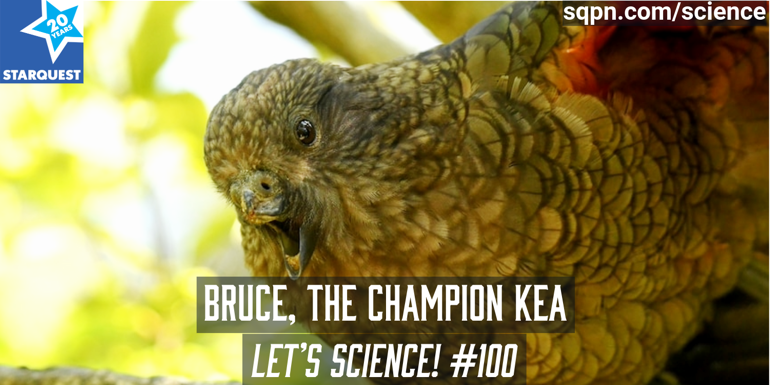
SCI100: A kea parrot with no upper beak shouldn’t be the alpha. Bruce is.
Keas are the world’s only alpine parrot, stocky birds with olive green plumage and brilliant orange under their wings. They live in the snow-capped mountains of New Zealand’s South Island, known for their intelligence, their complex social structures, and their habit of dismantling tourist gear. A kea’s upper beak is its most critical tool: curved, overlapping, used for foraging, climbing, and grooming.
Bruce lost his entirely, likely to a pest trap before he arrived at Willowbank Wildlife Reserve near Christchurch 12 years ago. A missing upper beak should mean a short, difficult life. Instead, researchers publishing in Current Biology found something no one expected.
He invented new tools.
Without a hook beak, Bruce can’t groom himself the way other keas do. So he picks up specific pebbles, holds them against his tongue, and uses them to comb his feathers. It’s the first documented case of self-medicated tool use in any bird species.
He also invented a new way to fight. Kea males establish dominance through a downward biting motion, using that curved upper beak to grab and pin opponents from above. Bruce can’t do that. So he developed what researchers named beak jousting: a horizontal spear-thrust with his lower mandible, aimed at the chest or head. Other birds have no defense against it. He won 100% of 36 high-stakes dominance fights.
Researchers measured corticosterone across the group. The alpha is usually the most stressed bird, constantly defending status. Bruce’s levels were the lowest. And because he can’t groom the top of his own head, other keas now do it for him, a form of social tribute that researchers say is unique among males in his group.
Caroline Knight, Lino Saubolle, and Lindsay Sant walk through the science of how Bruce became alpha, what his story means for how biologists define disability in intelligent animals, and whether behavioral plasticity, the capacity to reshape behavior when circumstances demand it, might be the ultimate survival trait.
The episode also asks whether Bruce’s neural rewiring parallels neuroplasticity in humans, a question the researchers haven’t tackled yet, but probably should.
Get all new episodes automatically and for free:
 Apple Podcasts
 YouTube
 Spotify
 Amazon Music
 TuneIn
 RSS
RSSFollow by Email | Listen and subscribe on YouTube.
Help us continue to offer Let’s Science. Won’t you make a pledge at SQPN.com/give today?
Links for this episode:
- A disabled kea parrot is the alpha male of his circus
- Bruce the disabled NZ kea uses his broken beak to dominate male rivals
- If you enjoy Let’s Science, check out Caroline and Lindsay and Lino’s other show, Catholics of Oz.
- Leave us a review on Apple Podcasts!
- Email us feedback or comments to [email protected]
- Be part of the StarQuest Discord community at SQPN.com/discord
Want to Sponsor A Show?
Support StarQuest’s mission to explore the intersection of faith and pop culture by becoming a named sponsor of the show of your choice on the StarQuest network. Click to get started or find out more.