One Giant Leap (Again): The Science of Artemis II
Podcast: Download
SCI099: For the first time since 1972, humans traveled beyond low Earth orbit. The Artemis II mission sent four astronauts on a 10-day journey around the moon — breaking the distance record set by Apollo 13 and ushering in a new era of human spaceflight.
Caroline Knight, Lindsay Sant, and Lino Saubolle start from the beginning: the retirement of the Space Shuttle in 2011 and the development of NASA’s Space Launch System, the most powerful rocket ever successfully flown. They trace its lineage — the RS-25 engines inherited from the shuttle, the five-segment solid rocket boosters, and the Orion spacecraft, the only part of the stack designed to return to Earth.
Before Artemis II could carry humans, Artemis I had to prove the system could survive deep space. In November 2022, a 25-day uncrewed mission flew three mannequins — including two female phantoms rigged with radiation sensors — through the harsh conditions of the lunar environment and back. That mission cleared the way for the crew of Integrity.
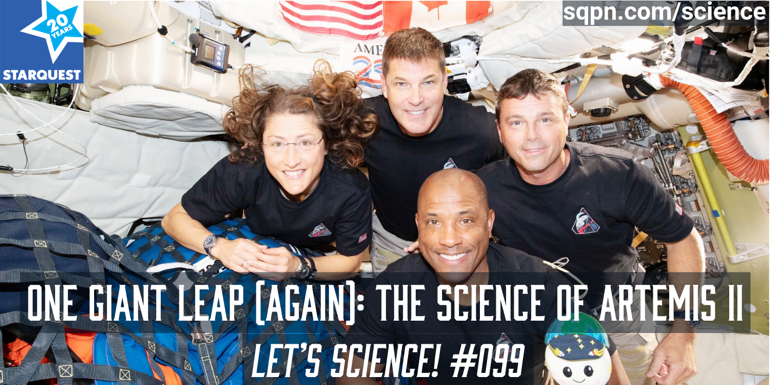
The Artemis II crew made history on multiple fronts. Reid Wiseman commanded the mission; Victor Glover became the first person of color to fly a lunar mission; Christina Koch became the first woman to travel beyond low Earth orbit; and Jeremy Hansen became the first non-American to reach deep space. Their camaraderie — and Glover’s openly expressed faith — made for compelling viewing throughout the 10 days.
The mission produced remarkable science: the crew mapped the lunar far side’s Oriental Basin, identified previously unseen color variations in lunar geology (browns and oranges invisible from Earth), and became the first humans to visually witness micrometeorite impacts on the moon’s surface in real time. They also observed a total solar eclipse from deep space — nearly an hour without atmospheric interference. And they named a newly identified crater “Carol,” in honor of Commander Wiseman’s late wife.
Not everything went smoothly. The spacecraft’s toilet malfunctioned when pipes froze in the cold of deep space, requiring the crew to reposition the ship toward the sun to warm them. The alternative methods they fell back on are left to the imagination.
Splashdown came on April 10, 2026 — a textbook re-entry at nearly 24,000 mph, the heat shield enduring temperatures approaching half the surface temperature of the sun, and recovery by the USS John P. Murtha in the Pacific Ocean southwest of San Diego.
The discussion closes with what comes next: Artemis III docking tests with Blue Origin and SpaceX lunar landers, and NASA’s long-term vision of a permanent human presence on the moon.
Get all new episodes automatically and for free:
 Apple Podcasts
 YouTube
 Spotify
 Amazon Music
 TuneIn
 RSS
RSSFollow by Email | Listen and subscribe on YouTube.
Help us continue to offer Let’s Science. Won’t you make a pledge at SQPN.com/give today?
Links for this episode:
- Artemis II Launch Coverage – Live Science
- Best Images from Artemis II – The Planetary Society
- Micrometeorite Impacts Observed by Artemis II Astronauts – Space.com
- Scientific Research During Artemis II – Canadian Space Agency
- If you enjoy Let’s Science, check out Caroline and Lindsay and Lino’s other show, Catholics of Oz.
- Leave us a review on Apple Podcasts!
- Email us feedback or comments to [email protected]
- Be part of the StarQuest Discord community at SQPN.com/discord
Want to Sponsor A Show?
Support StarQuest’s mission to explore the intersection of faith and pop culture by becoming a named sponsor of the show of your choice on the StarQuest network. Click to get started or find out more.