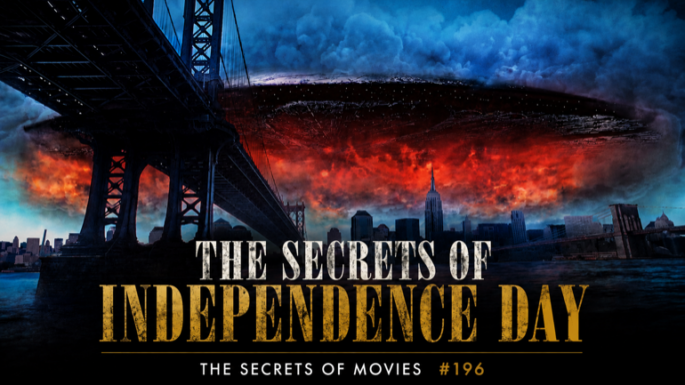
The Secrets of Independence Day
Podcast: Download
SCR196: The most celebrated image in Independence Day required no CGI. The White House explosion was a 1/24-scale plaster model, five feet tall, packed with 40 explosives and furnished with actual dollhouse furniture so the debris would look like it came from a real building. Roland Emmerich’s crew filmed it at 300 frames per second and stretched it into eight seconds of screen time. They blew up the model once, kept the footage, and never topped it.
Thirty years after its July 4, 1996 release, Independence Day stands as the defining blockbuster of its era — $817 million worldwide on a $75 million budget, briefly the second-highest-grossing film in history behind Jurassic Park. For episode 196 of Secrets of Movies, Dom Bettinelli, Jeff Haecker, and Rob Leonardi revisit Roland Emmerich’s alien invasion epic on its 30th anniversary — the same week the United States marks its 250th.
The mid-90s context matters. Post-Cold War, pre-9/11, the era that thought it might be the end of history. The panel discusses what that optimism looks like embedded in the film: nations that would soon be at war share airspace in the Iraqi desert, waiting for American leadership that never has to demand attention. A coalition assembled without argument. A world that felt — briefly — like it had figured things out. Independence Day could only have been made when it was.
The cast is a 90s time capsule. Fox pushed back hard on Will Smith; Emmerich and producer Dean Devlin won that fight. Alongside Smith, the film fills every role with a recognizable face: Jeff Goldblum, Bill Pullman, Brent Spiner, Mary McDonnell (before Battlestar Galactica made her president of the colonies), Harvey Fierstein, Adam Baldwin, Randy Quaid, Harry Connick Jr., Mae Whitman as the president’s daughter, and Judd Hirsch as David’s father. The panel traces the film’s influence on the disaster movie genre it effectively defined — Deep Impact, Armageddon, and The Day After Tomorrow all built on its template.
What the panel returns to is the film’s treatment of its heroes. A Jewish scientist. A Black Marine fighter pilot. A disgraced crop duster with alien abduction claims on his record. Nobody is there to represent a demographic. They just show up and save the world. In 2026, that reads as refreshing rather than dated.
The presidential speech — written in five minutes as a placeholder and never changed — draws on Shakespeare’s St. Crispin’s Day address and Dylan Thomas’s “Do Not Go Gentle into That Good Night.” The panel discusses what it captures about American ideals that travel, and whether the message lands differently 30 years on.
Get all new episodes automatically and for free:
 Apple Podcasts
 YouTube
 Spotify
 Amazon Music
 TuneIn
 RSS
RSSFollow by Email | Listen to this episode and subscribe on YouTube.
Help us continue to offer Secrets of Movies and TV Shows. Won’t you make a pledge at SQPN.com/give today?
Links for this episode:
- Leave us a review on Apple Podcasts!
- Join the conversation at the StarQuest Facebook page.
- Be part of the StarQuest Discord community at SQPN.com/discord
- Email us feedback or comments to [email protected]
Want to Sponsor A Show?
Support StarQuest’s mission to explore the intersection of faith and pop culture by becoming a named sponsor of the show of your choice on the StarQuest network. Click to get started or find out more.