Tech Memento Mori, Revisited
Podcast: Download
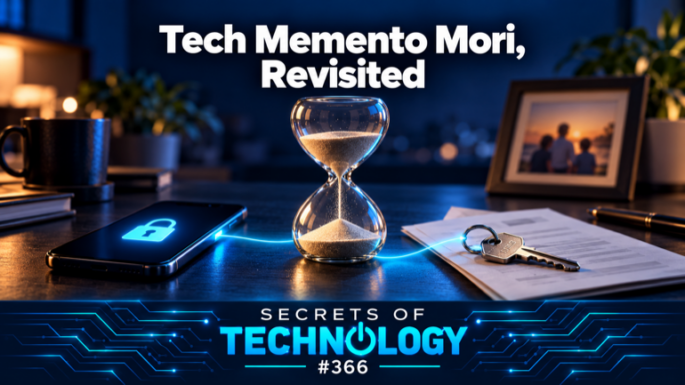
TEC366: If you died tonight, could the person handling your affairs get into your phone? Your email? The account the electric bill autopays from? Back in TEC118 the answer was “only if you left a list.” In 2026 the big platforms have official doors for this, and they still leave out the most important part.
Dom Bettinelli and Tom Grelinger revisit Tech Memento Mori five years later. They start with what aged well: an inventory of every account, a password manager with a printed emergency kit, a home inventory, and the free Big Book of Everything checklist. Tom adds the hard part, keeping it all current, and the local logins that never make it into a password manager.
Then they walk through the digital legacy planning tools that now exist. Apple Legacy Contact hands over photos, messages, notes and backups, but not purchased media or the passwords and passkeys in iCloud Keychain, and your contact needs both an access key and a death certificate. Google’s Inactive Account Manager works like a dead man’s switch, sending your data and a message you wrote to up to 10 people. Facebook can memorialize a profile so the birthday reminders stop. Dom and Tom compare the three approaches and talk about what they would want for their own families.
They also flag a deadline that didn’t exist in 2021: Google may delete a personal account, Gmail and Google Photos included, after two years without a sign-in. That matters for an aging parent’s account and for the family videos many people keep privately on YouTube.
The real inheritance is still the password manager. Dom and Tom cover the 1Password Emergency Kit, Bitwarden Emergency Access, why passkeys can’t go in a paper notebook, and what the law lets your executor see. Under the framework most states use, your executor may see who you emailed but can’t read the messages unless your will says so. This is not legal advice: ask your lawyer about explicit digital-asset language.
Why does a Catholic show keep coming back to this? Memento mori. The Catechism tells us remembering our mortality shows we have only a limited time, and the Church encourages us to prepare for the hour of our death. Getting your digital affairs in order is charity toward the people you leave behind.
In the headlines, Withings now charges new accounts $99.50 a year to sync health data, and people are using AI coding tools to strip ads and bloatware from their smart TVs. For Picks of the Week, Tom recommends Feedly and Dom recommends Joanna Stern’s YouTube channel.
 Apple Podcasts
 YouTube
 Spotify
 Amazon Music
 TuneIn
 RSS
Get all new episodes automatically and for free:
Follow by Email | Listen to this episode and subscribe on YouTube.
Help us continue to offer Secrets of Technology. Won’t you make a pledge at SQPN.com/give today?
Links for this episode:
- TEC118: Tech Memento Mori
- The Big Book of Everything
- How to add a Legacy Contact for your Apple Account (Apple Support)
- About Inactive Account Manager (Google Account Help)
- Adding a Legacy Contact (Meta, February 2015)
- Updating our inactive account policies (Google, May 2023)
- About your Emergency Kit (1Password Support)
- About Emergency Access (Bitwarden Help)
- iOS 26 passkey and password transfer (9to5Mac)
- Fiduciary Access to Digital Assets: RUFADAA (Nolo)
- Catechism of the Catholic Church, 1005–1014
- YubiKey
- Withings Now Charges $99.50/Year to Sync Data (Tech Insider)
- RENPHO
- Wyze Cam Plus
- Eufy
- Aqara
- People Are Using AI to Make Their Smart TVs Dumb Again (TechCrunch)
- dumbtv (GitHub)
- cleanyourtv
- Shorpy
- NetNewsWire
- Leave us a review on Apple Podcasts!
- Join the conversation at the StarQuest Facebook page.
- Be part of the StarQuest Discord community at SQPN.com/discord
- Email us feedback or comments to [email protected]
Picks of the Week:
- Tom: Feedly
- Dom: Joanna Stern’s YouTube channel
Want to Sponsor A Show?
Support StarQuest’s mission to explore the intersection of faith and pop culture by becoming a named sponsor of the show of your choice on the StarQuest network. Click to get started or find out more.
Disclaimer: Hosts, panelists, and guests may have a financial interest in the companies discussed through investments or other means. Their opinions and recommendations are not affected and do not present a conflict of interest. We offer this statement in the interest of full disclosure.