Freeze, Thaw, Fire: The Science of Reviving Frozen Brains
Podcast: Download
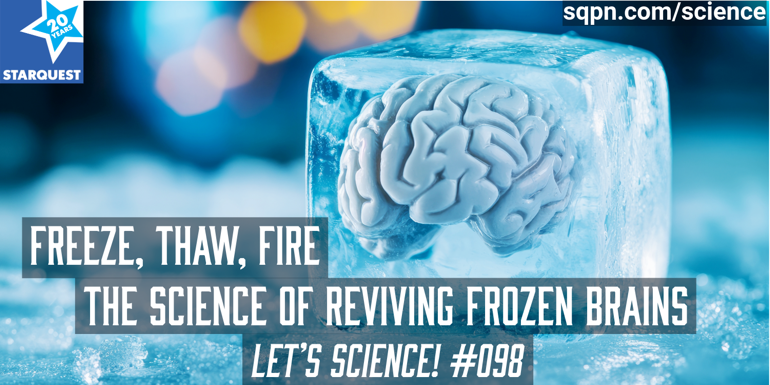
SCI098: Freeze a mouse brain, thaw it out, and it wakes up. That’s no longer science fiction — it’s the result of a landmark study from Friedrich-Alexander University in Germany, and Caroline Knight is here to explain exactly how they pulled it off, with Lindsay Sant asking all the right questions.
The central obstacle in cryobiology has never been the cold itself — it’s ice. As water molecules freeze, they form hexagonal crystalline lattices that behave like microscopic blades, shredding cell membranes and severing the synaptic bridges that store memory and identity. For the brain, the damage has historically been catastrophic and irreversible.
The research team bypassed freezing entirely through vitrification — cooling tissue so rapidly (hundreds of degrees per minute) that water solidifies into a glass-like state without ever forming ice crystals. The enabling compounds are cryoprotective agents like DMSO and ethylene glycol — biological antifreeze. The catch: these chemicals are toxic to cells at warmer temperatures, requiring careful removal as the tissue thaws.
Rinsing them out too fast triggers osmotic shock: the concentration gradient pulls water into the cells, bursting them. The team’s solution was a hyper-oncotic solution — high osmotic pressure that gradually draws cryoprotectants out while balancing pressure across the cell membrane, allowing neurons to return to their natural state.
Their target: the hippocampus CA1 region, often called the librarian of the mind, responsible for encoding new memories and spatial navigation. Mouse hippocampus tissue was frozen at -150°C for seven days. After controlled rewarming and electrical stimulation, the team observed long-term potentiation (LTP) — the cellular mechanism of learning, in which high-frequency neural activity strengthens connections between neurons. LTP surviving the freeze means the molecular machinery of memory is still intact.
The neurons fired electrical signals. Their membranes held. Their mitochondria restarted and resumed energy production. Behavior was described as near-normal in the study.
Lindsay and Caroline also discuss the implications for organ transplant preservation, the ethical questions around applying the technique to living subjects, and — on a practical note — exactly why you should never put a severed finger in the freezer.
Get all new episodes automatically and for free:
 Apple Podcasts
 YouTube
 Spotify
 Amazon Music
 TuneIn
 RSS
RSSFollow by Email | Listen and subscribe on YouTube.
Help us continue to offer Let’s Science. Won’t you make a pledge at SQPN.com/give today?
Links for this episode:
- If you enjoy Let’s Science, check out Caroline and Lindsay and Lino’s other show, Catholics of Oz.
- Leave us a review on Apple Podcasts!
- Email us feedback or comments to [email protected]
- Be part of the StarQuest Discord community at SQPN.com/discord
Want to Sponsor A Show?
Support StarQuest’s mission to explore the intersection of faith and pop culture by becoming a named sponsor of the show of your choice on the StarQuest network. Click to get started or find out more.