Keeping Humanity at the Center of the AI Age
Podcast: Download
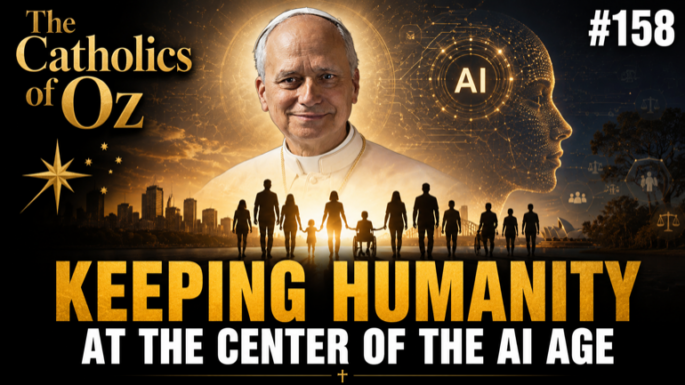
COZ158: Can the Church keep the human person at the center of the AI age? That’s the question at the heart of this episode, as Dom Bettinelli sits down with Lindsay Sant and Caroline Knight to think through Pope Leo XIV’s AI encyclical, Magnifica humanitas.
Dom argues the document is far richer than the “the Pope is against AI” headlines suggest. Leo is opening a conversation, not closing one — treating artificial intelligence as a genuinely powerful tool, like nuclear power, that demands moral reflection while humanity is still learning what it can do. The panel connects Leo XIV to his namesake Leo XIII and Rerum Novarum, reading the whole encyclical as an invitation to apply Catholic social teaching on artificial intelligence to a moment of enormous cultural change. The stakes, Dom says, come down to people: what the Church means by human dignity, why some technology companies now hold near-supranational power over smaller nations, and why the Church — universal by nature — belongs at the table.
The conversation doesn’t shy away from the risks. Chatbots are built to be agreeable, and that pull toward flattery can lead vulnerable users into unhealthy attachment or real harm. The answer, the group agrees, isn’t only better guardrails from tech companies; it’s families, parishes, and communities teaching people how to use these tools in a spiritually, emotionally, and mentally healthy way. They also weigh AI in high-stakes decisions — healthcare rationing, “AI actors,” and the digital resurrection of performers from Peter Cushing to Val Kilmer to the fully synthetic Tilly Norwood — and ask where the line falls between animation and replacing human artistry altogether.
Along the way, Dom shares what’s ahead for StarQuest, which turns twenty this year: the new season-by-season podcast Secrets of Television, a free companion app for Jimmy Akin’s Mysterious World, and a brand-new saints podcast he’s launching in September, Holy Troublemakers.
Then Caroline takes the mic for a science segment on the Chernobyl radiation-eating fungus. Cladosporium sphaerospermum doesn’t just survive inside the ruined reactor — it thrives, using the pigment melanin in a process researchers call radiosynthesis. Drawing on the 2007 PLOS ONE study led by Ekaterina Dadachova and a later experiment aboard the International Space Station, Caroline explains how a living, self-healing fungal layer might one day serve as a radiation shield for space travel and a mission to Mars — innovation drawn out of one of history’s worst disasters.
It’s faith, culture, science, and a little sci-fi, all in one conversation.
Get all new episodes automatically and for free:
 Apple Podcasts
 YouTube
 Spotify
 Amazon Music
 TuneIn
 RSS
RSSFollow by Email | Listen to this episode and subscribe on YouTube.
Help us continue to offer Catholics of Oz. Won’t you make a pledge at SQPN.com/give today?
Links for this episode:
- Pope Leo XIV’s encyclical Magnifica humanitas (full text, Vatican)
- Rerum novarum (Pope Leo XIII, 1891)
- Chernobyl disaster
- Cladosporium sphaerospermum (the radiation-eating fungus)
- Radiotrophic fungus
- Radiosynthesis
- 2007 PLOS ONE study — “Ionizing Radiation Changes the Electronic Properties of Melanin and Enhances the Growth of Melanized Fungi” (Dadachova et al., Albert Einstein College of Medicine)
- ISS fungal-shield study — cultivation of Cladosporium sphaerospermum aboard the International Space Station (Frontiers in Microbiology, 2022)
- Claude (Anthropic)
- ChatGPT (OpenAI)
- Grok (xAI)
- Daredevil: Born Again
- Monarch: Legacy of Monsters
- Silo (and the novel series by Hugh Howey)
- The Pitt
- Pluribus
- Breaking Bad
- Better Call Saul
- Ted Lasso
- Fringe
- Boston Blue
- Bosch / Bosch: Legacy
- Ballard
- The Last of Us
- Star Trek: Strange New Worlds
- Mission: Impossible (film series)
- Rogue One: A Star Wars Story (digital Peter Cushing)
- Independence Day
- Minions & Monsters (latest Despicable Me / Minions film)
- Tilly Norwood (AI-generated “actress”)
- Leave us a review on Apple Podcasts!
- Email us feedback or comments to [email protected]
- Also check out our other podcast Let’s Science!
Want to Sponsor A Show?
Support StarQuest’s mission to explore the intersection of faith and pop culture by becoming a named sponsor of the show of your choice on the StarQuest network. Click to get started or find out more.
Thank you to Moon Shadow Studios
This episode of The Catholics of Oz was edited by Patrick McCaffrey of Moon Shadow Studios. To have your own audio professionally edited by Moon Shadow Studios visit them at their web site MoonShadowStudios.biz.