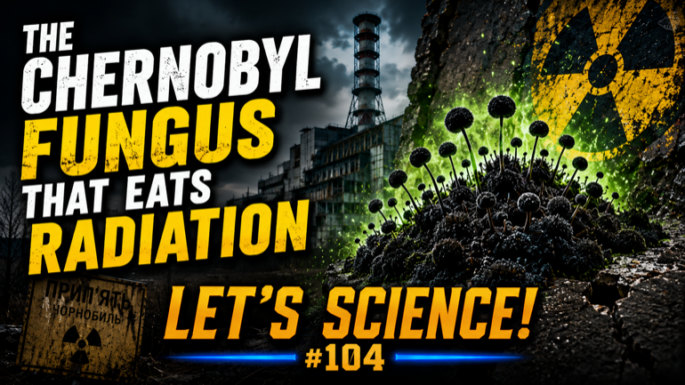
The Chernobyl Fungus That Eats Radiation
Podcast: Download
SCI104: A black fungus that feeds on radiation sounds like science fiction, but researchers found exactly that growing on the walls of the Chernobyl reactor — and it may hold a key to sending humans safely to Mars.
Caroline Knight brings Lindsay Sant and Dom Bettinelli the strange story of Cladosporium sphaerospermum, the radiotrophic fungus discovered thriving inside Reactor 4 five years after the 1986 disaster. Robots sent into the pitch-black, highly radioactive basement expected a sterile wasteland. Instead they found thick, velvety black carpets of fungus growing on the concrete — and even on the corium, the hardened lava of melted nuclear fuel.
How does a living thing not just survive but flourish in one of the most radioactive places on Earth? The answer is melanin, the same dark pigment that colors human skin and shields our DNA from ultraviolet light. In a 2007 study published in PLOS ONE, Ekaterina Dadachova and her team at the Albert Einstein College of Medicine showed that melanin does more than block radiation — it can capture the energy of gamma rays and convert it into chemical energy the cell can use. They called it radiosynthesis, a radiation-powered cousin of photosynthesis. In controlled tests, melanized fungi starved of food but bathed in radiation grew dramatically, while melanin-free albino mutants didn’t grow at all.
That discovery opened a striking possibility for space travel. Beyond Earth’s magnetosphere, astronauts lose the natural shield that protects us from cosmic radiation, and hauling heavy lead or polyethylene into orbit is enormously expensive. A black fungus that eats radiation offers a different route: a living, self-healing radiation shield. Flown to the International Space Station, a fungal layer just two millimeters thick blocked roughly two percent of the incoming radiation — and models suggest a layer around 21 centimeters thick could make the Martian surface survivable. Better still, a living shield repairs itself and grows faster precisely when a solar flare delivers more radiation. Instead of carrying tons of shielding from Earth, a crew could pack a few grams of dried spores and grow their protection on arrival.
Caroline, Lindsay, and Dom also wander into self-healing Roman concrete, using water as radiation shielding, brain-hijacking fungi, and a distinctly Catholic sense of wonder at innovation rising out of disaster — proof that, as the panel puts it, nature always finds a way.
Get all new episodes automatically and for free:
 Apple Podcasts
 YouTube
 Spotify
 Amazon Music
 TuneIn
 RSS
RSSFollow by Email | Listen and subscribe on YouTube.
Help us continue to offer Let’s Science. Won’t you make a pledge at SQPN.com/give today?
Links for this episode:
- Chernobyl disaster
- Cladosporium sphaerospermum (the radiation-eating fungus)
- Radiotrophic fungus
- Radiosynthesis
- 2007 PLOS ONE study — “Ionizing Radiation Changes the Electronic Properties of Melanin and Enhances the Growth of Melanized Fungi” (Dadachova et al., Albert Einstein College of Medicine)
- ISS fungal-shield study — cultivation of Cladosporium sphaerospermum aboard the International Space Station (Frontiers in Microbiology, 2022)
- If you enjoy Let’s Science, check out Caroline and Lindsay and Lino’s other show, Catholics of Oz.
- Leave us a review on Apple Podcasts!
- Email us feedback or comments to [email protected]
- Be part of the StarQuest Discord community at SQPN.com/discord
Want to Sponsor A Show?
Support StarQuest’s mission to explore the intersection of faith and pop culture by becoming a named sponsor of the show of your choice on the StarQuest network. Click to get started or find out more.