Not All Roads Lead to Rome
Podcast: Download
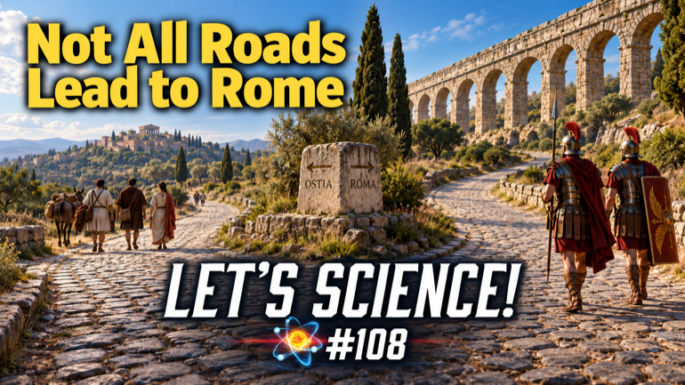
SCI108: “All roads lead to Rome,” the saying goes. It turns out that’s not quite true. Roman roads covered the empire, but a lot of them never went near the capital.
With Caroline away this week, Lindsay Sant takes on the science segment with Lino Saubolle. The topic: new research from archaeologist Tom Brughmans of Aarhus University and colleagues, whose Itiner-e project is the most detailed Roman roads map yet made, charting nearly 300,000 kilometers (about 186,000 miles) of road across the Roman Empire.
In a paper published in Nature Communications in September 2026, the team used that dataset to test three assumptions about the Roman road network. First, the “all roads lead to Rome” myth. Rome was the hub of Mediterranean shipping, but over land the network was spread across the empire, clustered around provincial capitals, which probably helped with administration and tax collection. For travel over land, cities such as Byzantium, later Constantinople, sat in a more central position than Rome did.
Second, were Roman roads straight? Only where the land allowed it. The Romans were exceptional engineers, but the terrain decided the route. Third, the idea that we still walk on Roman roads today is overstated. Some roads survive, some were rebuilt after the Industrial Revolution, and others vanished altogether.
Lindsay explains why the roads mattered to the “silent majority,” not just emperors and armies. They carried people, animals, goods, ideas and, unfortunately, disease, and they helped feed a city of about a million people that depended on grain shipped from Alexandria. Many were upgrades of older roads, not new builds. Lino wonders whether it was all Roman concrete (it wasn’t, though Lindsay would like to think some of it was), and fans of the game Civilization will recognize the logic of building roads between cities.
Lindsay calls this Roman Roads Part One, and says the researchers themselves describe their findings as the tip of the iceberg.
The episode closes with listener feedback from the Let’s Science channel on the StarQuest Discord about citizen science: Dom Bettinelli remembers running SETI@home on an old Mac, and listener Dr. Aragorn recorded temperatures during the 2017 total solar eclipse and joined occultation observations for the RECON network, which put his name on a scientific paper about Hi’iaka, a moon of the dwarf planet Haumea.
Get all new episodes automatically and for free:
 Apple Podcasts
 YouTube
 Spotify
 Amazon Music
 TuneIn
 RSS
RSSFollow by Email | Listen and subscribe on YouTube.
Help us continue to offer Let’s Science. Won’t you make a pledge at SQPN.com/give today?
Links for this episode:
- If you enjoy Let’s Science, check out Caroline and Lindsay and Lino’s other show, Catholics of Oz.
- Leave us a review on Apple Podcasts!
- Email us feedback or comments to [email protected]
- Be part of the StarQuest Discord community at SQPN.com/discord
Want to Sponsor A Show?
Support StarQuest’s mission to explore the intersection of faith and pop culture by becoming a named sponsor of the show of your choice on the StarQuest network. Click to get started or find out more.