Friction Maxxing: The Internet Rediscovers That Struggle Is Good for You
Podcast: Download
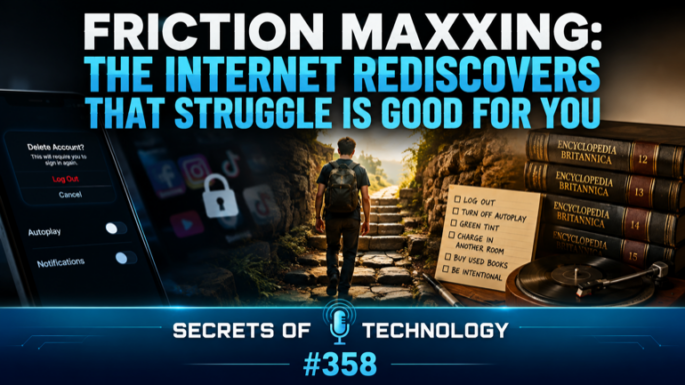
TEC358: Somewhere between one-click ordering and autoplay, doing things stopped asking anything of us. A New York magazine columnist gave the backlash a name in January and the internet ran with it: friction-maxxing, the practice of deliberately choosing the slower, harder, more annoying option, on the theory that the easy one has been quietly costing you something.
Dom Bettinelli, Fr. Joseph Sund, and Pat Scott take the trend seriously, then take it somewhere the trend pieces don’t. Kathryn Jezer-Morton coined the term in The Cut, arguing that tech companies have spent two decades framing ordinary human friction — boredom, effort, awkwardness — as a defect to be engineered away, and that convenience at all costs is quietly dehumanizing. The panel’s answer is that she is right, and that it is also about seventeen centuries old.
So what does friction-maxxing look like? Not a checklist, and emphatically not a streak, since a streak defeats the premise. Log out of accounts so you have to type the password again. Turn off autoplay where the setting exists. Move apps into the App Library, or lock them behind Face ID so opening a social app takes one deliberate extra tap. Grayscale the display — Fr. Joseph Sund makes the case for a green tint instead, since your eyes adapt to gray and never quite adapt to green. Charge the phone in another room. Buy a used set of encyclopedias, for the sake of everything you find on the way to the thing you were looking for.
Then the conversation turns. Fr. Joseph Sund describes high schoolers who have never lived a day without an iPhone rebelling by buying vinyl. Pat Scott reframes the trend as intentionality rather than deprivation: we are not here only to consume, but to participate. And Dom Bettinelli draws the line the episode is really about. Friction-maxxing as secular self-optimization aims at better focus and dopamine regulation; Christian asceticism aims at redemptive suffering, growth in virtue, and detachment from comfort for the love of God and neighbor. Both are about becoming a better person. They are not the same project.
Underneath runs a harder question: what happens to human capability when AI removes the last of the friction. The headline segment covers ChatGPT for Teens — break reminders, parent-set Quiet Hours, a study-focused default mode, and ages estimated by AI — and asks whether platform-level age verification is real child safety or legal cover.
Picks of the week: Everything, the instantaneous Windows file search; Claude for Teachers, Anthropic’s free tier for verified K-12 educators; and Wispr Flow, AI dictation for Mac, Windows, iOS, and Android.
 Apple Podcasts
 YouTube
 Spotify
 Amazon Music
 TuneIn
 RSS
RSSGet all new episodes automatically and for free:
Follow by Email | Listen to this episode and subscribe on YouTube.
Help us continue to offer Secrets of Technology. Won’t you make a pledge at SQPN.com/give today?
Links for this episode:
- Brooding: In 2026, I Resolve to Friction-Maxx
- Friction-Maxxing Tips: How to Add More Friction to Your Tech Use | Mashable
- The Digital Sabbath: A Rule for Life
- OpenAI Introduces ‘ChatGPT for Teens’ Experience Amid Scrutiny Over Child Safety | CNN Business
- Leave us a review on Apple Podcasts!
- Join the conversation at the StarQuest Facebook page.
- Be part of the StarQuest Discord community at SQPN.com/discord
- Email us feedback or comments to [email protected]
Picks of the Week:
- Pat: Voidtools: Everything
- Fr. Joseph: Claude for Teachers \ Anthropic
- Dom: Wispr Flow | Effortless Voice Dictation
Want to Sponsor A Show?
Support StarQuest’s mission to explore the intersection of faith and pop culture by becoming a named sponsor of the show of your choice on the StarQuest network. Click to get started or find out more.
Disclaimer: Hosts, panelists, and guests may have a financial interest in the companies discussed through investments or other means. Their opinions and recommendations are not affected and do not present a conflict of interest. We offer this statement in the interest of full disclosure.